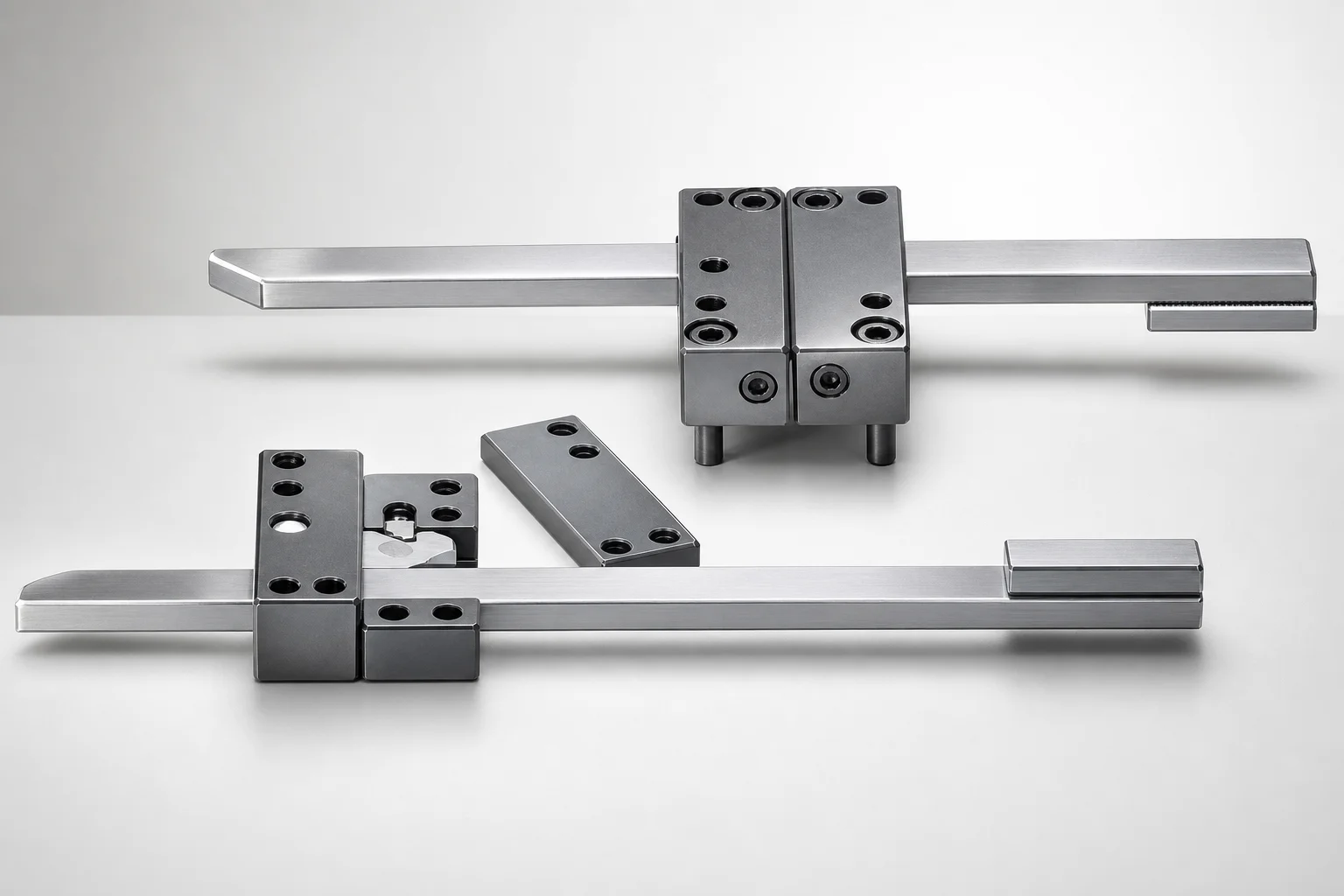
Parting Lock Sets Standard Size
Parting Lock Sets standard size provide dependable locking for light, medium, or heavy load parting cycles, helping maintain alignment and stability throughout mold or fixture operation.
- Secure locking mechanism supports consistent parting alignment under varying loads
- Modular set options include slide holder, cam holder, and release bar components
- Designed for PLL, PLM, and PLS configurations to improve repeatability in operation
- Robust construction helps protect sensitive systems while supporting long service life
Specifications
17 configurations available
| Load Capacity | Parts | Appl. | type |
|---|---|---|---|
| 4t(40KN) or lower | Set | For PLL | - |
| 1.8t(20KN) or lower | Set | For PLM | - |
| - | Cam holder set | For PLM | - |
| - | Slide holder unit | For PLM | - |
| 1t(10KN) or lower | Set | For PLS | - |
| - | Cam holder set | For PLS | - |
| - | Release bar long type | For PLS | - |
| - | Slide holder unit | For PLS | - |
| - | Cam lock | For PLS | - |
| - | Cam lock | For PLL | - |
| - | Cam lock | For PLM | - |
| - | Release bar | For PLS | - |
| - | Release bar | For PLL | - |
| - | Release bar | For PLM | - |
| - | Slide lock | For PLS | - |
| - | Slide lock | For PLL | - |
| - | Slide lock | For PLM | - |
Product Guide
Application Scenarios+
Parting lock sets are used inside injection molds and mold-related fixtures to hold the parting plane position during opening/closing cycles. In automotive connector and bracket molds, the locking function helps maintain alignment when parting loads fluctuate, supporting repeatable core/cavity engagement and preventing misalignment under cycle-to-cycle variation.
For appliance and consumer electronics housings, this standard-size set is typically selected for PLL, PLM, or PLS configurations where you want stable locking for light to medium parting cycles. The available load capacities (up to 4t/40kN, 1.8t/20kN, or 1t/10kN or lower) make it suited to applications with controlled forces rather than extreme heavy-load opening.
In industrial enclosure and service fixture builds, the modular options—such as slide holder, cam holder, and release bar components—allow designers to match the locking architecture to the required PLL/PLM/PLS layout, improving positional reliability.
- Choose based on parting cycle load level and the required PLL/PLM/PLS configuration
- Select the appropriate modular components (cam/slide/release bar) to complete the locking set
Material & Process Details+
The provided product data focuses on load capacity and component set configuration, not on a specific steel grade, heat treatment, or measured hardness (HRC). As a result, this variant should be evaluated against your mold design’s mechanical requirements using the supplier’s material certificate/datasheet for the exact alloy and surface treatment.
In general, parting lock components are expected to balance wear resistance (to resist cam and release-contact wear) with toughness (to avoid cracking under shock loads during opening). If your project cycles include higher shock or debris exposure, you may need components with higher wear-resistant treatments (e.g., nitriding or tempered conditions) versus standard through-hardening.
- Action for engineers: confirm the steel grade and heat treatment state (quenched & tempered, nitrided, etc.) and the target hardness in HRC before final selection
- Trade-off to check: higher hardness typically improves wear resistance but can reduce toughness if not properly tempered
Sizing & Selection Guide+
Select the correct set by matching two criteria from the specifications: application type (PLL/PLM/PLS) and parting load capacity. Use the load rating class that corresponds to your expected parting forces: 4t (40kN) or lower, 1.8t (20kN) or lower, or 1t (10kN) or lower.
Next, choose the correct parts configuration for the mechanical interface you designed. Available options include: Set, Cam holder set, Slide holder unit, Release bar long type, Cam lock, Release bar, and Slide lock. For PLL/PLM/PLS layouts, use the component set that aligns with the required locking pathway and motion transfer via the cam/slide/release bar elements.
- Rule of thumb: ensure the chosen load class has margin for peak loads during opening under worst-case conditions
- Tolerances/fit: confirm installation clearances and locating requirements for the specific PLL/PLM/PLS tooling arrangement, as exact dimensional tolerances are not provided in the input data
- Configurable vs fixed: the sizing is fixed by the standard-size set selection; component type (cam/slide/release bar) is what you configure
Frequently Asked Questions
Which load capacity class should I select for a parting lock set to cover my injection mold opening forces?+
Choose the load capacity class based on the maximum parting force your mechanism experiences. This product offers classes of 4t (40kN) or lower, 1.8t (20kN) or lower, and 1t (10kN) or lower.
For safe operation and repeatability, select the class with sufficient margin for peak loads during opening/closing cycles.
How do I choose between Set, Cam holder set, and Slide holder unit for PLL vs PLM vs PLS configurations?+
The selection is driven by your required locking architecture: this standard-size series is specified for PLL, PLM, or PLS applications.
Use the full Set when you need the complete assembly, or select the matching modular pieces such as Cam holder set and Slide holder unit when integrating into an existing controller layout.
What does 'Release bar long type' imply when matching components to the mold parting mechanism?+
“Release bar long type” indicates a specific release-bar geometry intended to match the stroke and linkage layout of your parting mechanism. The product family also includes a general Release bar, so the long-type should be selected when your design requires the extended configuration.
Confirm compatibility with your PLL/PLM/PLS layout because exact dimensional offsets are not included in the provided data.
Are there different steel grades or heat-treated options available for this parting lock set standard size?+
The provided metadata does not list a steel grade, heat treatment state, or HRC hardness. To ensure correct wear and toughness performance, request the material certificate/datasheet from Axiom Molds for the exact alloy and treatment used in this series.
This is especially important if your cycle loads are near the selected class limits.
Can I mix components like Cam lock and Slide lock with a release bar to build a custom set for my mold?+
The specification lists individual part options including Cam lock, Slide lock, Release bar, and Release bar long type, in addition to complete sets.
You can use these individual components when assembling a configuration that matches your PLL/PLM/PLS requirements, but verify mechanical interface compatibility and clearances for reliable locking.
Related Products
Need Custom Specifications?
Our engineering team can help with custom configurations, material selection, and volume pricing.