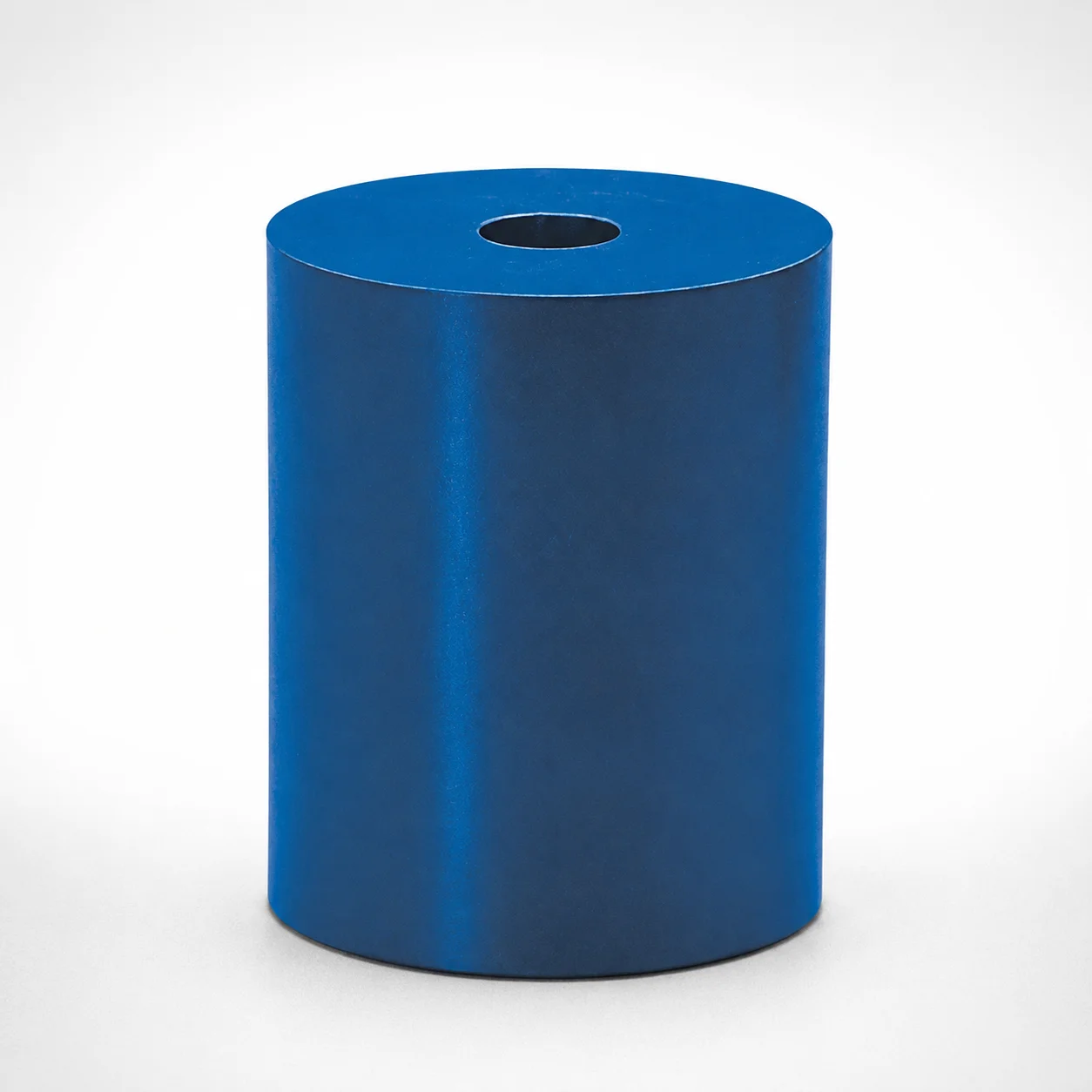
MAZ Urethane Spring
MAZ urethane spring is designed with a counterbore configuration to support secure seating in urethane spring applications. It offers stable retention for repeatable assembly performance when outside diameter and length need to be matched.
- Counterbore feature helps ensure consistent positioning in the mounted housing
- Selectable outer diameter and length support fitment to your assembly
- Urethane spring construction provides stable spring force for controlled return
- Suitable for industrial tooling components requiring reliable spring retention
Specifications
13 configurations available
| D (Outer Diameter) (mm) | L (L dimension) (mm) | type |
|---|---|---|
| 15 | 15 | - |
| 15 | 20 | - |
| 15 | 25 | - |
| 20 | 20 | - |
| 20 | 25 | - |
| 20 | 30 | - |
| 25 | 25 | - |
| 25 | 30 | - |
| 25 | 35 | - |
| 25 | 40 | - |
| 30 | 30 | - |
| 30 | 35 | - |
| 30 | 40 | - |
Product Guide
Application Scenarios+
MAZ urethane springs are used in injection mold opening/closing tooling where a controlled, repeatable return force is required. The counterbore geometry supports secure seating in spring pockets, helping the spring maintain consistent position under cycling loads.
- Mold-opening controller assemblies: Install the spring in a counterbored seat within a moving controller or actuator housing to stabilize spring alignment and reduce variation between cycles. The selectable outer diameter (15–30 mm) and length (15–40 mm) make it easier to match the stroke and available space.
- Urethane spring-based return mechanisms: Use this variant where urethane spring behavior is needed for smooth force characteristics and reliable retraction. The counterbore helps ensure repeatable mounting and controlled force transfer during mold return.
- Industrial tooling components: In housings that require reliable retention without looseness, the counterbore configuration supports stable assembly, improving consistency for automation and long-run production.
Material & Process Details+
This product is a urethane spring, selected for applications that benefit from stable, controllable elastic return rather than high-hardness metal spring behavior. Urethane typically provides damping and smooth force response, which can help reduce stick-slip effects during mold motion.
- Material behavior: Urethane’s elasticity supports a stable spring force for controlled return while maintaining seating pressure in the counterbore.
- Heat treatment relevance: For urethane, quenching, tempering, nitriding, or HRC hardness targets are not applicable in the same way they are for steel components. Performance is primarily governed by formulation and curing conditions, not steel heat treatment.
- Trade-off vs. steel springs: Compared with steel springs, urethane can offer smoother force characteristics and damping, but may be more sensitive to temperature and long-term compression depending on environment.
Sizing & Selection Guide+
Correct selection of D (outer diameter) and L (length) is essential to ensure proper seating in the counterbore and to achieve the intended return force.
- Match outer diameter (D): Choose D from 15, 20, 25, or 30 mm to fit the counterbored seat in your urethane spring mounting housing.
- Match length (L): Select L from 15, 20, 25, 30, 35, or 40 mm so the spring can preload correctly without bottoming in the pocket.
- Core/cavity interface consideration: Verify available axial space so the spring remains seated while accommodating mold cycle motion and any tolerance stack-up in the housing.
- Tolerance & fit: Confirm that your counterbore dimensions allow consistent seating pressure across repeated assemblies; use your mold’s standard tolerance approach to prevent loosening (too much clearance) or assembly interference (too tight fit).
Frequently Asked Questions
How do I choose the correct outer diameter (D) for the urethane spring in a counterbore housing?+
What length (L) should I specify to avoid coil/base bottoming in mold return mechanisms?+
Why is the counterbore configuration important for stable assembly in urethane spring systems?+
Is this MAZ urethane spring compatible with counterbore designs where outside diameter and length are variable by design?+
Do I need steel heat-treatment specifications (HRC, nitriding) for this urethane spring component?+
Related Products
Need Custom Specifications?
Our engineering team can help with custom configurations, material selection, and volume pricing.