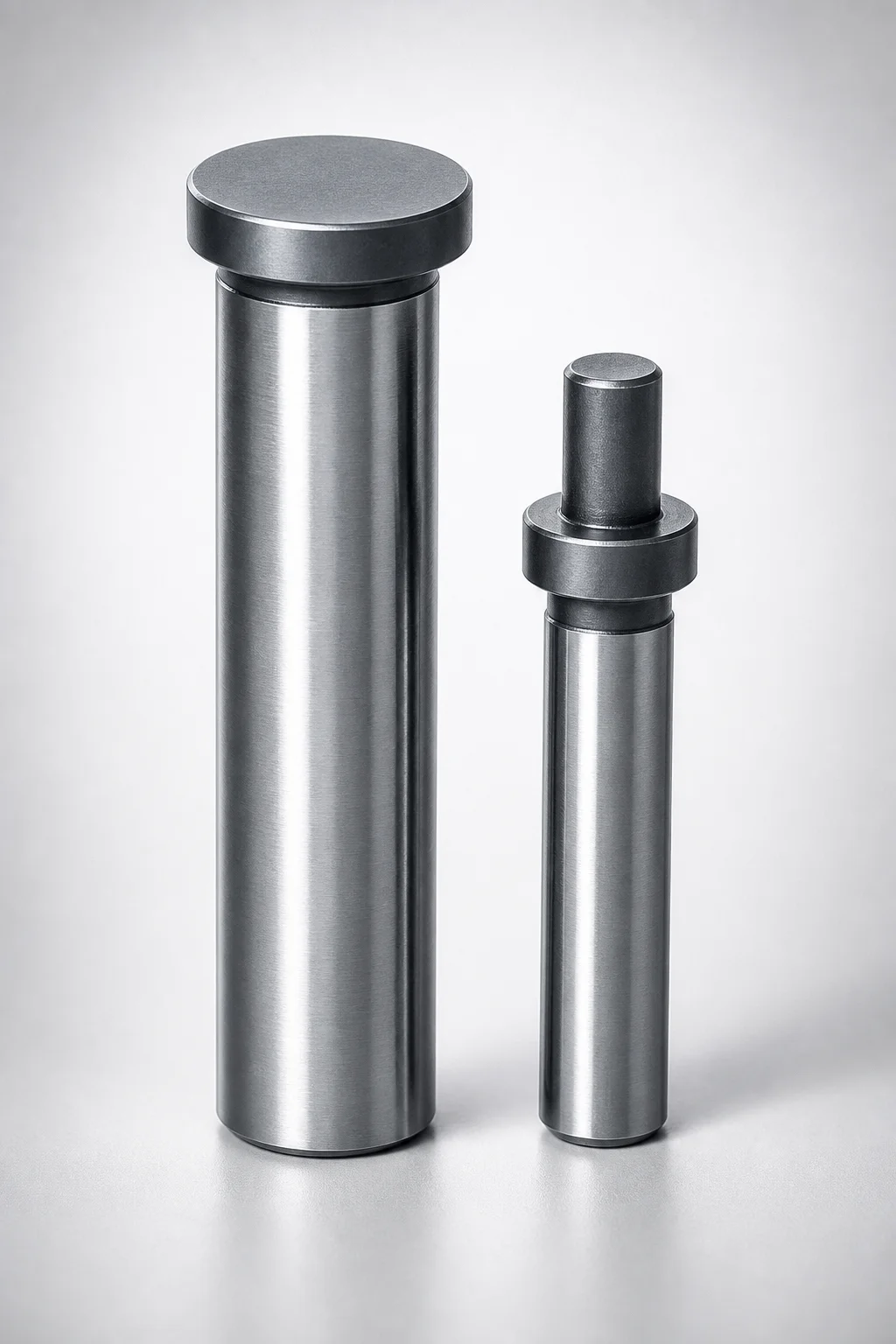
Pusher Pins for Runner Stripper Plates
Pusher Pins for Runner Stripper Plates (PSP type) are designed to support stable runner stripping and smooth ejection during mold opening. They help transfer pushing force efficiently to release molded components without scuffing.
- PSP pusher pin type engineered for consistent runner stripper operation
- Durable mold opening component construction for reliable cycling performance
- Compatible for designs requiring push-based part release control
- Commonly used in production molds with runner stripping and ejection
Specifications
7 configurations available
| D (Outer Diameter) (mm) | L (Length) (mm) | type |
|---|---|---|
| 6 | 10 ~ 50 | - |
| 8 | 10 ~ 50 | - |
| 10 | 10 ~ 50 | - |
| 13 | 10 ~ 70 | - |
| 16 | 10 ~ 70 | - |
| 20 | 20 ~ 80 | - |
| 25 | 20 ~ 80 | - |
Product Guide
Application Scenarios+
PSP-type pusher pins are used in injection molds that rely on runner stripper plate actuation during mold opening. In these systems, the pin transmits linear push force to the stripper plate to initiate runner and part release with controlled timing.
- Automotive connector and housing molds: Suitable for repetitive cycling runner stripping where consistent ejection reduces scuffing and cosmetic defects on narrow features.
- Packaging and appliance snap-fit components: The stable push action supports smooth part ejection, helping minimize drag marks when runners are closely routed to the gate area.
- General production molds with push-based release control: The broad diameter coverage (D 6–25 mm) and multiple length options (L 10–50, 10–70, 20–80 mm) make it adaptable to different stripper stroke lengths and cavity/core layouts.
Why this variant fits: The PSP configuration is specifically intended for runner stripper operation, enabling efficient force transfer to improve ejection stability while lowering damage risk under frequent production cycling.
Material & Process Details+
The provided product data specifies dimensional ranges only (D 6–25 mm; L 10–50, 10–70, 20–80 mm), and does not list a steel grade, hardness, heat treatment state, or nitriding/carburizing conditions. Because of this, material-property claims (e.g., HRC, wear resistance, or toughness) cannot be stated reliably from the current metadata.
For engineering selection, confirm the pusher pin steel grade and the heat treatment condition from the supplier’s specification sheet for the exact size you intend to use. In practice, materials for opening/stripping pins are chosen to balance wear resistance (to handle sliding contact and repetitive stroking) with toughness (to avoid chipping under impact loading).
- If multiple grades are offered, select the one matched to your cycle rate and contact conditions (e.g., runner stripper plate material and lubrication strategy).
- Verify the finished surface condition (polished/ground) to reduce friction and improve ejection consistency.
Sizing & Selection Guide+
Correct pusher pin sizing is primarily determined by the outer diameter D and the required working length L for your runner stripper plate mechanism.
- Choose D within 6–25 mm to match the stripper plate bore diameter and to avoid excessive clearance or binding. Larger D improves column stiffness but may require corresponding plate/guide adjustments.
- Choose L according to your stroke and stack-up: available ranges are 10–50 mm, 10–70 mm, and 20–80 mm. Select the longest length that still maintains proper engagement without bottoming out in the open/close travel.
- Match to cavity/core layout: ensure the pin position aligns with the stripper plate actuation zones so force is delivered uniformly for runner stripping.
Tolerance and fit considerations: Maintain appropriate clearance between pin and stripper plate/guide bores to account for thermal expansion and mold wear. If your mechanism uses guided alignment, target a fit that prevents lateral play while avoiding frictional lock-up.
Frequently Asked Questions
How do I select the pusher pin outer diameter (D 6–25 mm) for a runner stripper plate?+
Which pusher pin length range should I use (10–50, 10–70, or 20–80 mm) for my stripper stroke?+
What does “PSP type” imply for part ejection and runner stripping performance?+
Can these pusher pins be used in any push-based opening controller, or only specific stripper mechanisms?+
Do I need to consider wear resistance and hardness for these pusher pins in high-cycle production?+
Related Products
Need Custom Specifications?
Our engineering team can help with custom configurations, material selection, and volume pricing.