O-Rings for Mold Cooling
Static, dynamic, and space-saving O-rings engineered for sealing mold cooling channels, pipe connections, and plug interfaces under continuous thermal cycling.
All O-Ring Products (1)
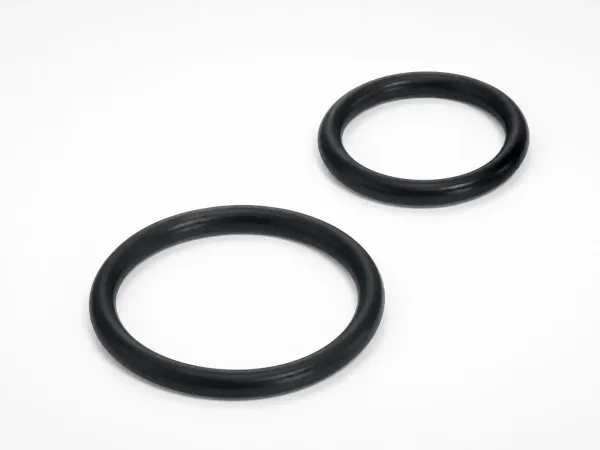
Choose the Right O-Ring Type
Follow this three-step decision process to select the correct O-ring type for your mold cooling application:
Selection tip: When in doubt between standard and space-saving, always choose standard — it provides higher sealing force and longer service life. Only use space-saving when physical constraints make standard grooves impossible. See our O-Ring Selection Guide for groove dimension tables.
O-Ring Sealing Principles for Mold Cooling
Understanding compression ratio, volumetric thermal expansion, and polymer degradation is key to preventing high-pressure waterline failure.
Compression Force & Squeeze Mechanics
An O-ring functions as a hyper-elastic seal by storing mechanical energy during assembly compression. The initial **compression ratio (squeeze)** must be held within critical bounds: $$\text{Static Seal: } 15\% \sim 25\% \quad \text{Dynamic Seal: } 10\% \sim 15\%$$ Falling below 10% squeeze allows coolant to bypass under pressure transients, while exceeding 30% squeeze induces severe shear stress and accelerates compression set (permanent plastic deformation). Additionally, because elastomer thermal expansion is $\approx 20\times$ higher than mold steel, the groove width must be sized to ensure the O-ring occupies no more than $85\%$ of the total groove volume, leaving a $15\%$ expansion cavity for hot fluid swell.
Thermal & Chemical Polymer Degradation
In standard cooling circuits, NBR (Nitrile) offers good tensile strength, but exposure to temperatures $>100^\circ\text{C}$ causes continuous cross-linking, transforming the rubber into a hard, brittle material that fractures under mold clamping vibrations. **FKM (Fluorocarbon)** maintains chemical stability up to $200^\circ\text{C}$ due to the strength of the Carbon-Fluorine bond, resisting degradation from biocides and soft-water rust inhibitors. EPDM is ideal for steam temperature regulation since it does not undergo water-induced hydrolysis, but it suffers immediate volume swell ($>100\%$) and tensile failure if it comes in contact with petroleum-based mold release oils.
Material rule: If your mold uses water cooling below 80°C, NBR is always the right choice. Switch to FKM only when temperature exceeds 80°C or the coolant contains aggressive additives. For a complete compatibility chart, see our O-Ring Material Guide.
O-Ring Pairing with Cooling Components
O-rings are used at every connection point in the mold cooling system. Standardize pairing sizes to prevent assembly errors:
ø6 mm Waterlines
Pairs with static O-rings of 4.8 mm ID and 1.9 mm wire diameter. Groove depth: 1.5 mm. Squeeze: 21%.
Compatible series: ORSO 4.8 (NBR) / ORSO 4.8-V (FKM)ø8 mm Waterlines
Pairs with static O-rings of 6.8 mm ID and 1.9 mm wire diameter. Groove depth: 1.5 mm. Squeeze: 21%.
Compatible series: ORSO 6.8 (NBR) / ORSO 6.8-V (FKM)ø10 mm Waterlines
Pairs with static O-rings of 8.8 mm ID and 2.4 mm wire diameter. Groove depth: 1.9 mm. Squeeze: 20.8%.
Compatible series: ORSO 8.8 (NBR) / ORSO 8.8-V (FKM)ø12 mm Waterlines
Pairs with static O-rings of 10.8 mm ID and 2.4 mm wire diameter. Groove depth: 1.9 mm. Squeeze: 20.8%.
Compatible series: ORSO 10.8 (NBR) / ORSO 10.8-V (FKM)Are You in the Right Place?
Elastomer seals have specific structural applications in injection mold waterlines. Verify your selection scope:
✅ You're in the right place if:
- You need seals that insert into grooves machined directly on internal mold parts (pipes, plugs, or core pins).
- You require metric (JIS B2401 compliant) or inch (AS568 standard) sizing for tight integration.
- You are sealing circuits against pressure up to 1.5 MPa under high thermal cycling.
🔄 Consider switching to:
- Need standard industrial hydraulic/pneumatic seal rings (e.g., standard round rings, U-cups, piston seals)? → See **General Industrial Seals**
- Need high-temp flat gaskets to seal mold plate interfaces? → See **Mold Plate Gaskets & Inserts**
About O-rings for mold cooling
O-rings for mold cooling provide the critical seal at every water connection point inside the mold — pipe-to-bore interfaces, plug installations, and plate-to-plate joints. Unlike general-purpose O-rings, mold cooling O-rings are specifically sized and rated for the thermal cycling, water pressure (typically 3-6 bar), and chemical exposure conditions inside injection molds. Available in static, dynamic, and space-saving configurations to match every sealing scenario in the cooling system.
Application Scenarios
Cooling Channel Seal Replacement
Routine maintenance replacement of worn O-rings at cooling pipe and plug interfaces — the most common cause of minor coolant leaks in aging molds.
NBR static O-rings provide reliable sealing for 100,000-250,000 shot cycles. Keeping spare O-rings in stock prevents costly production delays during scheduled maintenance.
Recommended → Standard Static O-Ring (NBR, 70 Shore A)
High-Temperature Mold Sealing
Molds running at elevated temperatures (80-200°C) for engineering plastics like PC, POM, PA — standard NBR O-rings degrade and leak within weeks.
FKM (Viton) O-rings maintain elasticity and sealing force at temperatures up to 200°C, providing 2-4 year service life even in high-temperature oil cooling circuits.
Recommended → Static/Dynamic O-Ring (FKM, 75 Shore A)
Thin-Wall Mold Sections
Mold areas where wall thickness limits groove depth to less than 2.5 mm — common in compact multi-cavity molds and small inserts.
Space-saving O-rings with 1.5 mm cross-section fit shallow grooves without compromising seal integrity. They maintain the same 15-25% compression ratio in a smaller envelope.
Recommended → Space-Saving Static O-Ring
Frequently Asked Questions
What is the difference between static, dynamic, and space-saving O-rings for mold cooling?+
What O-ring material is best for high-temperature mold cooling applications?+
How do I select the correct O-ring size for my mold cooling plug or pipe?+
How often should mold cooling O-rings be replaced?+
Engineering Resources
How to Select O-Rings for Mold Cooling
Step-by-step guide to choosing the right O-ring type based on motion, temperature, and groove design.
O-Ring Material Guide for Mold Cooling Applications
Chemical compatibility and temperature resistance chart for NBR, FKM, EPDM, and silicone O-ring materials.
Need a Custom Quote?
Specify your O-ring inner diameter, cross-section, material (NBR/FKM/EPDM), and application type (static/dynamic). Non-standard sizes and custom compounds available for special requirements.