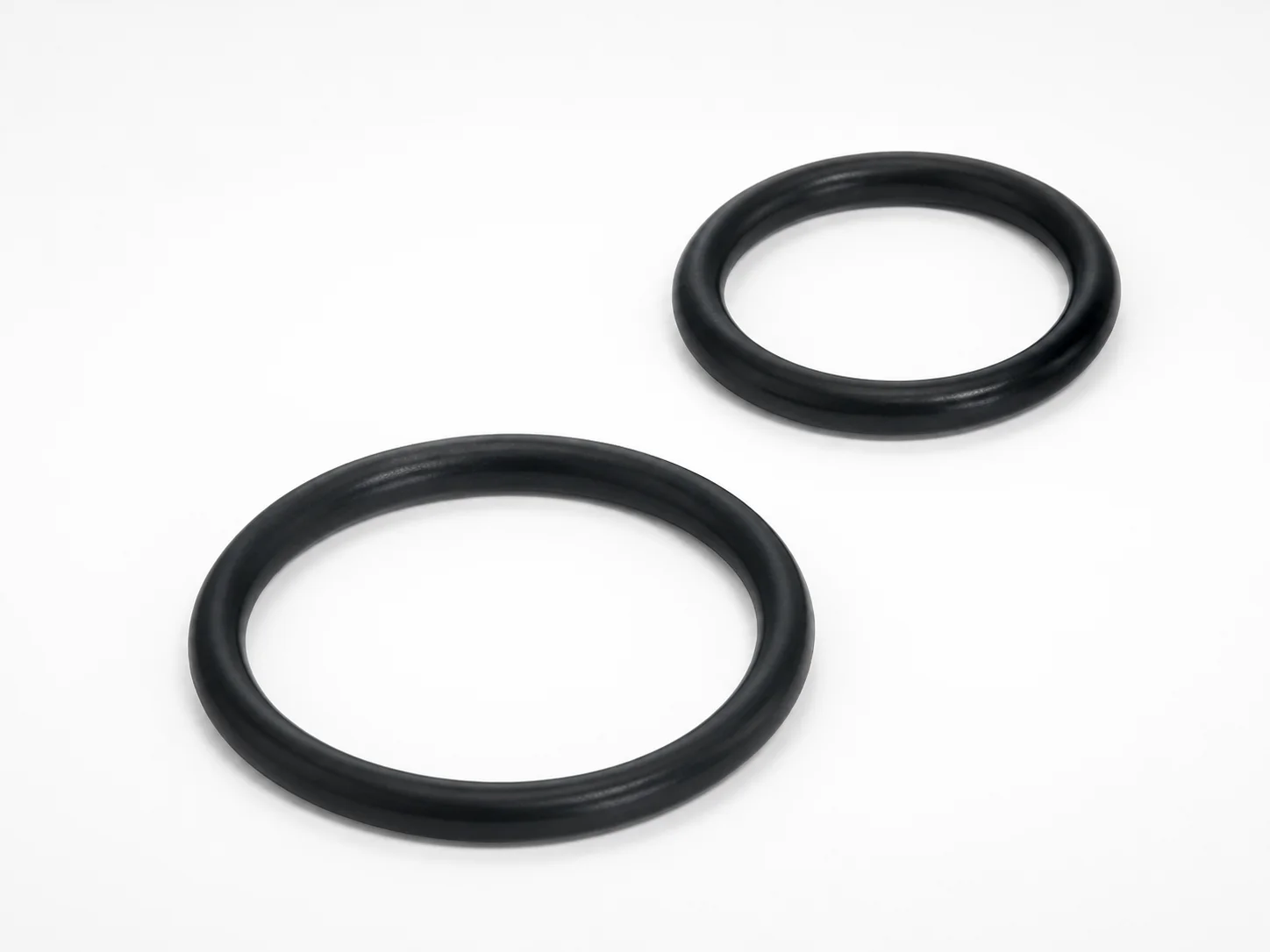
Space Saving Static O-Rings for Mold Interior
Space Saving Static O-Rings are mold interior seals engineered to prevent fluid or gas leakage in tight installation spaces. They maintain sealing integrity under pressure to protect sensitive hydraulic and pneumatic components.
- Optimized space-saving static design for limited-mount mold interiors
- Consistent sealing performance to reduce leakage in fluid and gas systems
- Durable construction maintains integrity under operating pressure
- Suitable for static sealing applications in industrial molds and equipment
Specifications
85 configurations available
| Category | No./JIS No. | Int. dia. (φ) | Wire dia. (Thickness) (mm) | type |
|---|---|---|---|---|
| Static type | G25 | 24.4 | 3.1 | - |
| Static type | G30 | 29.4 | 3.1 | - |
| Static type | G35 | 34.4 | 3.1 | - |
| Static type | G40 | 39.4 | 3.1 | - |
| Static type | G45 | 44.4 | 3.1 | - |
| Static type | G50 | 49.4 | 3.1 | - |
| Static type | G55 | 54.4 | 3.1 | - |
| Static type | G60 | 59.4 | 3.1 | - |
| Static type | G65 | 64.4 | 3.1 | - |
| Static type | G70 | 69.4 | 3.1 | - |
| Static type | G75 | 74.4 | 3.1 | - |
| Static type | G80 | 79.4 | 3.1 | - |
| Static type | G85 | 84.4 | 3.1 | - |
| Static type | G90 | 89.4 | 3.1 | - |
| Static type | G95 | 94.4 | 3.1 | - |
| Static type | G100 | 99.4 | 3.1 | - |
| Static type | G105 | 104.4 | 3.1 | - |
| Static type | G110 | 109.4 | 3.1 | - |
| Static type | G115 | 114.4 | 3.1 | - |
| Static type | G120 | 119.4 | 3.1 | - |
| Movable type | P3 | 2.8 | 1.9 | - |
| Movable type | P4 | 3.8 | 1.9 | - |
| Movable type | P5 | 4.8 | 1.9 | - |
| Movable type | P6 | 5.8 | 1.9 | - |
| Movable type | P7 | 6.8 | 1.9 | - |
| Movable type | P8 | 7.8 | 1.9 | - |
| Movable type | P9 | 8.8 | 1.9 | - |
| Movable type | P10 | 9.8 | 1.9 | - |
| Movable type | P11 | 10.8 | 2.4 | - |
| Movable type | P12 | 11.8 | 2.4 | - |
| Movable type | P14 | 13.8 | 2.4 | - |
| Movable type | P15 | 14.8 | 2.4 | - |
| Movable type | P16 | 15.8 | 2.4 | - |
| Movable type | P18 | 17.8 | 2.4 | - |
| Movable type | P20 | 19.8 | 2.4 | - |
| Movable type | P21 | 20.8 | 2.4 | - |
| Movable type | P22 | 21.8 | 2.4 | - |
| Movable type | P24 | 23.7 | 3.5 | - |
| Movable type | P25 | 24.7 | 3.5 | - |
| Movable type | P26 | 25.7 | 3.5 | - |
| Movable type | P28 | 27.7 | 3.5 | - |
| Movable type | P30 | 29.7 | 3.5 | - |
| Movable type | P31 | 30.7 | 3.5 | - |
| Movable type | P32 | 31.7 | 3.5 | - |
| Movable type | P34 | 33.7 | 3.5 | - |
| Movable type | P35 | 34.7 | 3.5 | - |
| Movable type | P36 | 35.7 | 3.5 | - |
| Movable type | P38 | 37.7 | 3.5 | - |
| Movable type | P39 | 38.7 | 3.5 | - |
| Movable type | P40 | 39.7 | 3.5 | - |
Product Guide
Application Scenarios+
This space-saving static O-ring solution is used inside injection mold tool interiors where hydraulic lines, pneumatic passages, or auxiliary cooling/actuation circuits must be sealed within a restricted envelope.
Scenario 1: Automotive connector and bracket molds – These tools often package manifold fittings, vacuum/air channels, and sensor interfaces close to moving parts. The static design supports leak prevention for fluids or gas without requiring reciprocating motion, helping maintain consistent process conditions.
Scenario 2: Medical device housing molds – Tight assemblies around precision inserts and clean-fluid pathways benefit from stable sealing integrity. This variant is suited to limited-space installations, reducing the need for bulky glands while maintaining a reliable static seal.
Scenario 3: General industrial molds with pneumatic/hydraulic interfaces – When connectors are mounted in the mold interior, a static seal helps prevent pressure loss and contamination from minor leakage.
- Use for static sealing where no sliding movement occurs
- Select by inner diameter and wire/thickness to fit the limited cavity space
Material & Process Details+
The provided data specifies the sealing form factor (static type, space-saving) and dimension sets (JIS numbers), but it does not list the elastomer grade or any heat-treatment condition. Therefore, material-specific heat treatment, hardness (HRC), and wear/toughness trade-offs cannot be stated from the supplied information.
What can be confirmed is that the product is manufactured for static O-ring sealing applications across a broad internal diameter range (2.5 ~ 119.4 mm) and multiple wire/thickness options (1.5 ~ 3.5 mm among the listed sizes). Material selection for O-rings is typically tied to fluid compatibility and temperature requirements; when you request a material or hardness datasheet, ensure it matches your hydraulic/pneumatic media and expected mold-interior temperatures.
- Heat treatment: Not specified in the input data (elastomer O-rings are commonly not “quenched & tempered” like steels)
- Hardness/wear: Not provided; confirm elastomer hardness and compression set resistance for your duty cycle
Sizing & Selection Guide+
Correct selection is primarily dimensional: match the O-ring’s inner diameter (φ) and wire dia./thickness to the static gland (seal recess) geometry in the mold interior.
- Inner diameter range: φ 2.5 ~ 119.4 mm
- Wire/thickness options (mm): 1.5, 1.9, 2.0, 2.4, 3.1, 3.5
1) Measure or specify the gland’s seal pocket such that the O-ring inner diameter corresponds to the required bore/port interface. 2) Choose the wire/thickness that provides the intended compression for a static type seal—too thin may under-fill the recess, while too thick may prevent proper assembly in limited space.
Use the listed JIS No. set (e.g., G25, G30, … up to G95 per the provided list) as the mapping reference when converting from design drawings to the exact catalog size. Tolerance and fit values are not included in the provided data, so confirm compression allowance and groove tolerances against your mold design standards.
Frequently Asked Questions
Which static O-ring dimensions should I match to the mold interior sealing groove?+
Use the inner diameter (φ) range of 2.5 ~ 119.4 mm and the listed wire/thickness options (1.5, 1.9, 2.0, 2.4, 3.1, 3.5 mm) to match your static gland geometry.
Because this is a static type seal, select dimensions based on the port/bore interface and recess depth that provide the intended compression without requiring motion compensation.
How do I map my required inner diameter to the correct JIS No. (e.g., G25–G95)?+
The product provides a JIS mapping list: G25, G30, G35, G40, … G95 (85 total). In practice, you map your design’s required φ within 2.5 ~ 119.4 mm to the corresponding JIS number.
Use the selected JIS number together with the required wire/thickness to ensure the exact cross-section matches the available limited space.
What thickness (wire dia.) options are available for space-saving static sealing in a mold interior?+
The listed wire dia. (thickness) options are 1.5, 1.9, 2.0, 2.4, 3.1, and 3.5 mm. This lets you fine-tune seal cross-section for limited envelope constraints while keeping a static sealing function.
Select thickness based on recess/land dimensions so the O-ring can seat properly without interfering with nearby tooling components.
Is this O-ring suitable for movable sealing in mold mechanisms?+
From the provided metadata, the specific variant is described as a static type and “space saving.” Static O-ring usage is intended for sealing where there is no reciprocating motion.
If your application involves sliding or repeated movement, you should verify whether a movable-type variant exists for your required JIS/diameter/thickness before selecting this static design.
What material properties (hardness, heat treatment) are included with this product?+
The supplied data does not specify elastomer grade, hardness, or any heat-treatment state. Because this is an O-ring sealing component, it is typically characterized by elastomer hardness and compression set performance, but those values are not included here.
To confirm material suitability, request the material datasheet for your target fluid/gas and operating temperature, rather than relying on HRC or steel heat-treatment parameters.
Need Custom Specifications?
Our engineering team can help with custom configurations, material selection, and volume pricing.