Thermal Pins (Heat Pipes) for Mold Cooling
Phase-change thermal conductive pipes that achieve 10,000-200,000 W/m·K effective conductivity — solving cooling challenges in deep cores, narrow pins, and hot spots where conventional water cooling cannot reach.
Products (1)
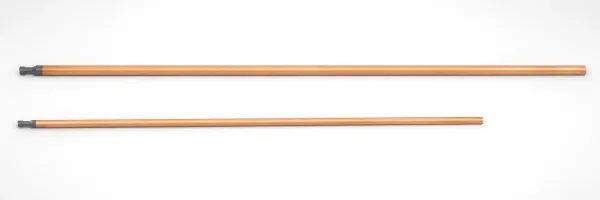
How Heat Pipe Technology Works
Heat pipes exploit phase-change thermodynamic cycles and capillary forces to transfer thermal energy at rates up to 1000× faster than solid copper.
Phase-Change Heat Transfer & Capillary Cycle
A heat pipe (thermal pin) is a hermetically sealed copper tube evacuated to a vacuum of $\approx 10^{-3}\text{ Pa}$, containing a precise volume of working fluid (deionized water) and lined with a multi-porous sintered copper powder wick. The thermodynamic cycle operates continuously through three distinct phases:
1. Evaporation (Heat Input): Heat from the mold cavity vaporizes the working fluid at the core tip, absorbing the latent heat of vaporization ($\Delta H_{vap} \approx 2,260 \text{ kJ/kg}$).
2. Vapor Transport & Pressure Drive: The pressure differential created by evaporation drives the vapor through the central vapor core to the condenser end at near-sonic speeds.
3. Condensation (Heat Output): At the cooled base, the vapor condenses back to liquid, releasing its latent heat to the water channel.
For continuous operation, the capillary pressure ($\Delta P_c$) developed in the sintered wick must overcome the liquid and vapor pressure drops plus any gravitational head: $$\Delta P_c \ge \Delta P_l + \Delta P_v + \Delta P_g$$ If the liquid pressure drop exceeds the capillary limit, the evaporator suffers from **dry-out**, causing a sudden loss in heat transfer capability.
Why 10,000-200,000 W/m·K Equivalent Conductivity?
Solid copper conducts heat via lattice vibrations and free electrons, limited to $400 \text{ W/m·K}$. A heat pipe achieves an equivalent thermal conductivity ($k_{eff}$) of $10,000 \text{ to } 200,000 \text{ W/m·K}$ because it transports heat via mass convection of vapor. The phase transition transfers huge thermal energy over tiny temperature gradients, keeping the temperature difference along the entire pipe length ($\Delta T$) under $3^\circ\text{C}$ to $5^\circ\text{C}$. This near-isothermal performance allows heat pipes to extract thermal energy from deep cores that would otherwise act as heat sinks.
Mold-Specific Design & Orientation
For injection molds, the heat pipe is divided into: (1) **Evaporator section** (in contact with the hot core pin tip), (2) **Adiabatic section** (passing through intermediate plate layers), and (3) **Condenser section** (embedded in a water jacket in the backplate). Sintered powder wicks create high capillary pressure, allowing orientation-independent operation. However, tilting the mold so that the condenser end is lower than the evaporator end (gravity-assisted) increases liquid return velocity, raising the maximum heat transport limit ($Q_{max}$) by up to 25%.
Engineering note: Heat pipe effectiveness is measured by the temperature difference between the evaporator and condenser sections — a well-designed installation maintains ΔT < 5°C along the full length. For detailed installation procedures and performance data, see our Heat Pipe Technology Guide.
Is the Heat Pipe Investment Worth It?
Heat pipes cost 5-10× more per unit than baffles. Here's a framework to determine if the investment makes sense for your application.
| Factor | Conventional Baffle ($5-15) | Heat Pipe ($50-150) |
|---|---|---|
| Applicable Core Diameter | ≥ ø8 mm (needs drilled channel) | ≥ ø3 mm (press-fit into blind hole) |
| Max Depth:Diameter Ratio | ~15-20:1 | Unlimited |
| Water Connection | Required (supply + return) | Not required (sealed unit) |
| Maintenance | Descaling every 6-12 months | None (hermetically sealed) |
| Failure Mode | Gradual (scale buildup, O-ring wear) | Rare (vacuum loss, manufacturing defect) |
ROI formula: Payback = (Number of heat pipes × unit cost) / (Shots per year × cycle time savings per shot × machine hourly rate / 3600). For a detailed calculation template, see our Heat Pipe Cost-Benefit Framework.
About Heat Pipes for Mold Cooling
Thermal pins (also known as heat pipes or cooling pins) represent the highest-performance cooling technology available for injection mold internal cooling. By exploiting the latent heat of vaporization — where a working fluid continuously evaporates, transports, and condenses — heat pipes achieve effective thermal conductivities 100-1000× higher than solid copper. They are the definitive solution for cooling challenges that conventional baffles and pipes cannot solve: narrow core pins below ø8 mm, deep features with extreme depth:diameter ratios, and locations where water plumbing is geometrically impossible.
MISUMI's thermal conductive pipes are copper-bodied with sintered powder wick construction, charged with deionized water for the 30-250°C operating range standard in injection molding. Available in multiple diameters and lengths, they are installed by press-fitting into blind holes — no water connections, no maintenance, 10+ year service life.
Application Scenarios
Hot Spot Elimination in Deep Cores
Tall boss features (50-150 mm depth, ø4-6 mm) that create persistent hot spots causing sink marks, long hold times, and dimensional variation between cavities.
Heat pipes press-fit into the core tip extract heat at rates 100× faster than conduction through steel alone. A single ø4 mm heat pipe can eliminate a hot spot that no baffle could address — because you can't drill a ø4 mm cooling channel.
Recommended → Thermal Conductive Pipe, ø4-6 mm × custom length
Cycle Time Reduction on Thick-Wall Parts
Parts with thick wall sections (4-8 mm) where cooling time dominates the cycle — even with optimized conventional cooling, the thick sections hold up the entire cycle.
Heat pipes installed directly behind the thick section surface deliver localized cooling intensity that reduces the governing cooling time by 15-35%. The rest of the mold can use standard baffles.
Recommended → Thermal Conductive Pipe, ø6-10 mm × matched to feature depth
Cooling in Moving Mold Components
Rotating cores, unscrewing cores, and collapsible cores where water connections would interfere with the mechanical motion — yet the moving component generates significant heat.
Heat pipes require no external connections — they're sealed, self-contained units. Install in the moving component and let the condenser end contact a cooled surface during mold closing. No hoses, no rotary joints, no leak risk.
Recommended → Thermal Conductive Pipe, orientation-independent sintered wick
Frequently Asked Questions
How does a heat pipe work in mold cooling?+
What is the thermal conductivity improvement of heat pipes vs conventional baffles?+
In what mold cooling applications are heat pipes most effective?+
What are the installation requirements for thermal conductive pipes in molds?+
What is the operating temperature range for mold cooling heat pipes?+
Engineering Resources
Understanding Heat Pipe Technology for Mold Cooling
Phase-change heat transfer explained — how heat pipes achieve extreme conductivity in mold cooling applications.
When to Invest in Heat Pipes: A Cost-Benefit Framework
Decision framework for evaluating heat pipe ROI based on cycle time savings and annual production volume.
Need a Custom Quote?
Specify your core pin diameter, feature depth, and operating temperature range. We'll recommend the optimal heat pipe diameter and length for your application. Custom diameters and lengths available.