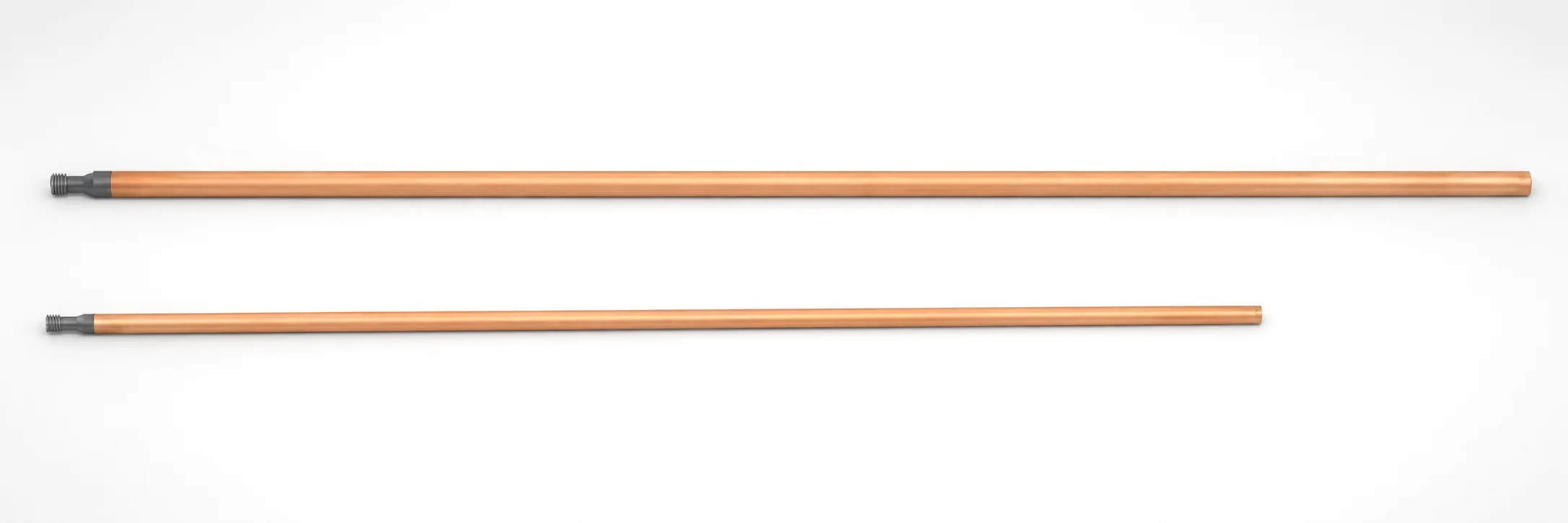
WHP Type Thermal Conductive Pipes for Cooling Mold
WHP type thermal conductive pipes for cooling mold are engineered to provide reliable heat transfer and stable temperature control in demanding molding and industrial setups. Their corrosion-resistant construction supports consistent thermal performance to help protect equipment over time.
- High heat transfer efficiency for dependable cooling and mold temperature stability
- Durable, corrosion-resistant material selection for long-term heat exchange reliability
- Optimized WHP type pipe construction to support consistent thermal performance
- Used for cooling circuits in molds and industrial heat transfer systems
Specifications
60 configurations available
| D (Outer diameter) (mm) | L (L dimension) (mm) | type |
|---|---|---|
| 2 | 35 | - |
| 2 | 40 | - |
| 2 | 45 | - |
| 2 | 50 | - |
| 2 | 55 | - |
| 2 | 60 | - |
| 2 | 65 | - |
| 2 | 75 | - |
| 2 | 85 | - |
| 2 | 105 | - |
| 2 | 125 | - |
| 2 | 145 | - |
| 3 | 40 | - |
| 3 | 45 | - |
| 3 | 50 | - |
| 3 | 55 | - |
| 3 | 60 | - |
| 3 | 65 | - |
| 3 | 75 | - |
| 3 | 85 | - |
| 3 | 105 | - |
| 3 | 125 | - |
| 3 | 145 | - |
| 4 | 50 | - |
| 4 | 55 | - |
| 4 | 60 | - |
| 4 | 65 | - |
| 4 | 75 | - |
| 4 | 85 | - |
| 4 | 105 | - |
| 4 | 125 | - |
| 4 | 145 | - |
| 4 | 165 | - |
| 4 | 205 | - |
| 4 | 225 | - |
| 6 | 35 | - |
| 6 | 40 | - |
| 6 | 45 | - |
| 6 | 50 | - |
| 6 | 55 | - |
| 6 | 60 | - |
| 6 | 65 | - |
| 6 | 75 | - |
| 6 | 85 | - |
| 6 | 105 | - |
| 6 | 125 | - |
| 6 | 145 | - |
| 6 | 165 | - |
| 6 | 205 | - |
| 6 | 225 | - |
Product Guide
Application Scenarios+
This thermal conductive pipe variant is designed for mold interior cooling where stable cavity temperature directly impacts cycle time and part consistency. It is commonly applied in automotive connector and bracket injection molding lines, supporting uniform cooling around fine features to reduce thermal gradients during ejection.
It also fits small housings and consumer electronics enclosures that require compact, reliable cooling circuits. The compact outer diameter options (2 to 8 mm) allow engineers to route temperature-control lines in tight mold layouts without excessive drilling or obstruction.
For industrial heat-exchange tooling and auxiliary thermal systems, the corrosion-resistant construction helps maintain heat-transfer performance in long-running production environments where coolant chemistry can vary.
- Use it in cooling channels/circuits to maintain consistent mold temperature.
- Select the smaller OD variants for tight mold geometries and fine cooling layouts.
- Choose longer L dimensions (35 to 225 mm) to match local manifold-to-run spacing.
Material & Process Details+
The provided specifications focus on dimensional ranges and application intent; a specific steel grade, hardness (HRC), heat-treatment state, or proprietary alloy composition is not listed in the input data. Therefore, only general material intent can be stated: the WHP pipe construction is described as resistant to corrosion to support long service life and stable thermal performance.
Because hardness/heat-treatment details (e.g., quenched & tempered, nitrided, or pre-hardened) and wear-toughness trade-offs are not specified, engineers should confirm the exact material certificate or technical sheet for hardness (HRC), permissible operating conditions, and surface treatment.
- Confirm whether the pipe is an alloy steel, stainless alloy, or coated system before selecting for aggressive coolants.
- Verify any heat treatment or surface treatment that affects abrasion resistance and joining reliability.
- Compare only when multiple material grades are available with documented hardness and corrosion performance.
Sizing & Selection Guide+
Select the outer diameter D based on available space and the required cooling-line flow path within the mold. Available OD values are 2, 3, 4, 6, and 8 mm, which helps tailor the routing to compact mold steel sections and narrow runner/cavity neighborhoods.
Match the length L to the physical run needed between the connection points in your cooling circuit. This product is offered in L = 35 to 225 mm, so choose the longest feasible length that still satisfies interference constraints and assembly access.
- Use D (2–8 mm) to meet cavity/core proximity requirements and minimize drilling offsets.
- Use L (35–225 mm) to bridge manifold spacing and local thermal demand zones.
- Where tight tolerances or press-fit joints are used, verify coupling/interface tolerances from the mating component data (tolerance/fit details are not provided here).
For best thermal stability, avoid sharp obstructions and ensure consistent routing along the highest heat-density areas.
Frequently Asked Questions
Which outer diameter (D) should I choose for compact mold interior cooling channels?+
Choose from the available D (outer diameter) = 2, 3, 4, 6, or 8 mm based on the drilling allowance and how close the pipe can be positioned to the cavity/core. Smaller diameters (2–4 mm) are typically more suitable for tight mold layouts, while larger diameters (6–8 mm) can support broader cooling coverage where space allows.
How do I select the correct length (L) between manifold connections in a cooling circuit?+
Use the available L = 35 to 225 mm range to match the measured distance between your connection points. Select the length that provides full coverage of the intended thermal zone without causing interference with ejector mechanisms, vents, or structural steel.
Is this WHP thermal conductive pipe suitable for corrosion-prone coolant conditions?+
The product description specifies corrosion-resistant construction to support long-term heat exchange reliability. However, the input data does not include an exact material grade or surface treatment details, so confirm compatibility with your specific coolant chemistry and operating temperature range from the technical documentation.
What material grade or hardness (HRC) is used for the WHP pipe?+
The provided metadata does not list a specific steel/alloy grade, hardness in HRC, or heat-treatment condition (e.g., quenched & tempered, nitrided). To select for wear/erosion resistance and joining durability, request the material certificate and hardness/heat-treatment specification from Axiom Molds or the supplier documentation.
Does the available dimensional range limit my design for heat-transfer stability?+
The pipe supports practical cooling layouts through D = 2–8 mm and L = 35–225 mm. Dimensional constraints may affect how evenly you can distribute cooling near high-heat regions, so engineers should map heat density first and then assign the nearest matching D and L to each circuit segment.
Need Custom Specifications?
Our engineering team can help with custom configurations, material selection, and volume pricing.