Return Pins for Medium-Large Mold
Mechanical ejector plate return mechanism for medium to large injection molds. Two head styles — counterbore and tapped both ends — with 8mm head thickness for heavy-duty ejection systems.
Products
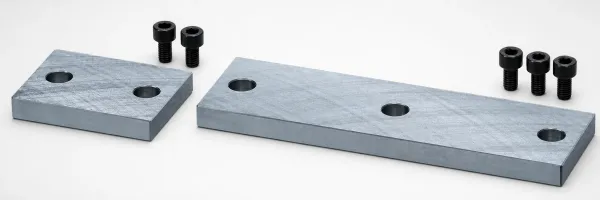
Head Style Selection
| Factor | Counterbore Head | Tapped Both Ends |
|---|---|---|
| Retention Method | Bolt through counterbore (one side) | Bolts at both ends |
| Length Precision | 0.1 mm increments | 1 mm increments |
| Security Level | Good | Maximum — double-locked |
| Best For | Standard molds, fine length control | Critical molds >1,000T, >1M cycles |
Selection tip: For most large molds running unfilled resins at standard temperatures, counterbore head with 0.1 mm length precision is the pragmatic choice. Reserve tapped-both-ends for high-tonnage (>1,000T) or ultra-high-cycle (>1M shot) applications where any pin loosening would be catastrophic. For detailed design comparisons and installation methods, see our Counterbore vs Tapped Return Pins — Which Head Style to Choose.
Why Return Pins Are Critical
Return pins serve three essential functions in large molds:
- Position guarantee: Ensures ejector plate returns to exact home position (±0.02 mm) every cycle
- Core protection: Prevents ejector pins from protruding into the cavity during mold close
- Timing control: In large molds with long ejection strokes (>150 mm), return pins ensure the plate is fully retracted before the mold halves meet
Engineering note: Return pins are often the most overlooked component in large mold design, yet their failure causes some of the most expensive damage — core crushing and cavity surface marring. For a detailed engineering analysis of return pin function and sizing guidelines, see our Why Return Pins Are Critical Even With Mechanical Ejector Retract.
Application
Large Mold Ejector Return
Molds >500 mm with ejection strokes exceeding 100 mm require positive return mechanism to prevent ejector pins from protruding during mold close.
Return pins provide a mechanical positive stop independent of the machine hydraulic retract — guaranteeing ±0.02 mm repeatability of ejector plate home position even after hydraulic seal wear or pressure fluctuation.
Recommended: Tapped Both Ends for molds >1,000T; Counterbore for standard applications
High-Cycle Production Molds
Molds running >20 shots/minute where ejector plate inertia causes overshoot past home position without positive stops.
At high cycle rates, the ejector plate decelerates rapidly. Without return pins as positive stops, the plate overshoots by 0.1-0.3 mm, causing flash at ejector pin locations on the next shot.
Recommended: Ø20-Ø25 mm Tapped Both Ends for maximum impact resistance
Decision rule: Return pins are mandatory in large molds where ejector plate inertia at high cycle speeds can cause overshoot past home position. For detailed guidance, see our Counterbore vs Tapped Return Pins — Which Head Style to Choose.