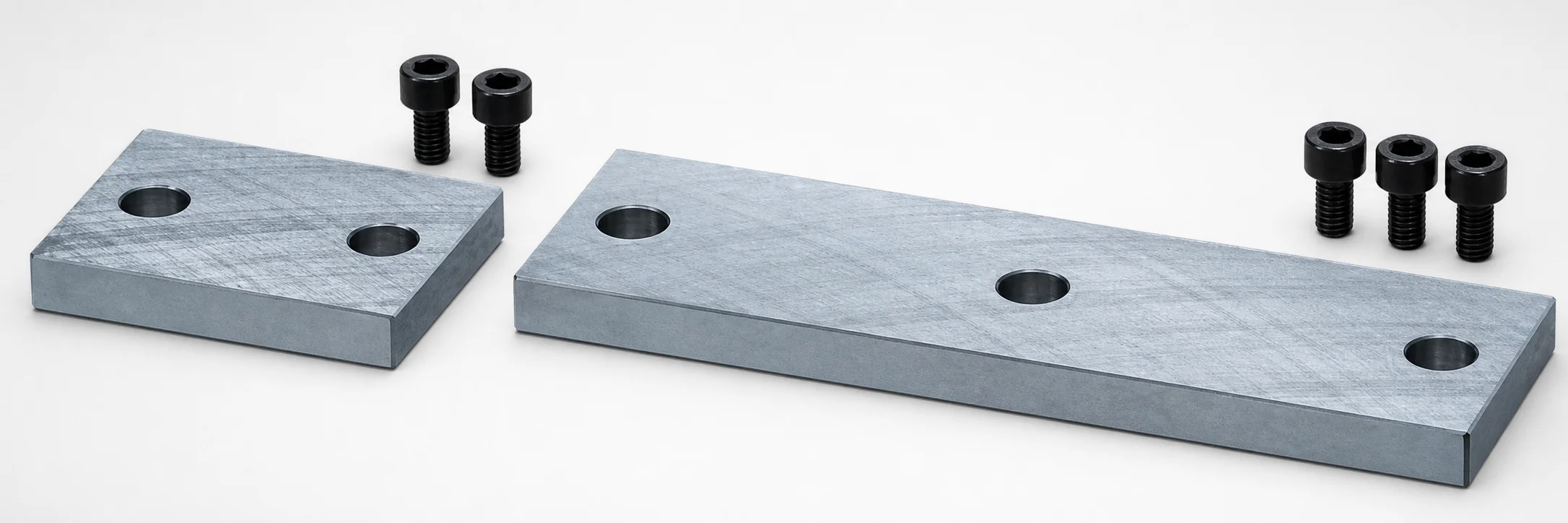
1045 Steel STPX Stopper Plates for Die Cast
1045 Steel STPX Stopper Plates for Die Cast provide heavy-duty support to stabilize mold assemblies. The plates securely hold components in place while absorbing shock to help maintain consistent forming quality.
- Heavy-duty steel construction improves stability during die-casting operations
- Shock-absorbing design helps prevent movement without compromising fit
- STPX type supports repeatable installation in mold support systems
- Suitable for injection molding and die-casting applications requiring reliable positioning
Specifications
5 configurations available
| H (Number of holes) (pieces) | A (External shape) (mm) | B (External shape) (mm) | T (Thickness) (mm) | type |
|---|---|---|---|---|
| 2 | 80 | 60 | 13 ~ 15 | - |
| 3 | 150 ~ 400 | 60 | 13 ~ 15 | - |
| 4 | 100 ~ 250 | 80 ~ 100 | 13 ~ 15 | - |
| 6 | 150 ~ 400 | 80 ~ 100 | 13 ~ 15 | - |
| 8 | 500 | 80 ~ 100 | 13 ~ 15 | - |
Product Guide
Application Scenarios+
Stopper plates like this are used inside large die-casting and injection mold assemblies to stabilize removable components during high-impact opening/closing cycles. In automotive connector housings and other high-volume cast parts, these plates help keep inserts and burr-cutting or support features positioned, reducing the risk of drift that can cause dimensional variation.
They are also effective for battery enclosure die-casting tooling where repeated shock loading and rapid thermal cycling can loosen lighter retaining elements. The STPX-type configuration is suited for repeatable installation within the mold support system, supporting consistent engagement over production runs.
- Die-casting component stabilization: holds parts securely and limits movement under cycle shock.
- Insert retention in large molds: helps preserve repeatable fit for repeatable forming quality.
- Cycle-load damping: supports shock absorption to maintain consistent positioning throughout production.
Material & Process Details+
This variant uses 1045 steel as the base material. 1045 is a medium-carbon steel (commonly associated with AISI 1045), offering a balanced mix of strength and toughness for heavy-duty mold support components. It is typically selected for applications where shock resistance and stable retention are more important than extreme wear performance.
Manufacturing generally involves machining the specified external geometry and hole pattern, followed by heat treatment to reach the required strength level. For stopper plates, parts are commonly quenched & tempered to improve hardness and maintain toughness, rather than only relying on surface-hardening.
- Hardness (HRC): depends on the specific Q&T target used by the supplier/manufacturer; design selection should be based on the required clamp/impact conditions.
- Wear vs. toughness trade-off: increased hardness improves abrasion resistance but can reduce impact toughness if over-tempered.
- Compared to alloy tool steels: 1045 is less specialized for high-wear sliding than nitriding-capable tool grades, but often more cost-effective for shock-loaded support plates.
Sizing & Selection Guide+
Select the stopper plate based on three governing dimensions: H (number of holes), A/B (external shape dimensions), and T (thickness).
For hole pattern matching, choose from H = 2, 3, 4, 6, or 8 to match the locating or mounting layout in your die-casting mold support system. Then verify the plate envelope: A is available as 80, 150–400, 100–250, or 500 (mm depending on the variant), while B is 60 or 80–100 (mm).
- Thickness T: fixed at 13–15 mm; confirm it provides sufficient stiffness without interfering with neighboring mold hardware.
- Fit/tolerance: ensure the hole count and overall shape conform to the mating features; small clearance variations are typically required to account for machining tolerances and assembly alignment.
- Core/cavity compatibility: prioritize clearance around the die-cast component path so the plate stabilizes without contacting moving tooling surfaces.
Frequently Asked Questions
How do I choose the correct hole count (H) for mounting this stopper plate in a die-casting mold support system?+
Which external dimensions (A and B) should I verify to ensure the plate fits the mold assembly envelope?+
Is this 1045 steel stopper plate suitable for shock-loaded die-casting cycles compared with harder tool steel grades?+
What thickness (T) options are available, and how should I use them for stiffness and clearance checks?+
Does STPX-type construction affect installation repeatability in mold tooling?+
Related Products
Need Custom Specifications?
Our engineering team can help with custom configurations, material selection, and volume pricing.