Cavity Inserts for Gas Vent
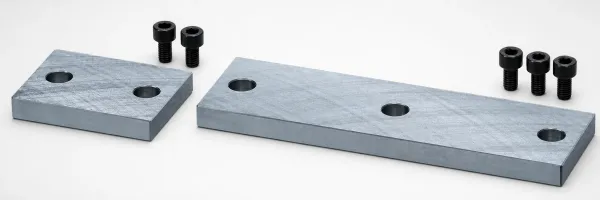
1049 porous steel venting inserts for large injection mold cavities. Controlled micro-porosity (5–20 μm) allows trapped air to escape while completely blocking resin entry — solving gas trap problems inaccessible to parting-line vents.
Products
How Gas Vent Inserts Work
Conventional venting relies on thin channels machined at the parting line. In large molds with deep pockets, ribs, or boss clusters far from the parting line, trapped air cannot reach these channels in time. Gas vent inserts solve this by providing distributed venting at the exact location where gas is trapped:
- Air displacement: As resin fills the cavity, it pushes air ahead. In deep pockets, this air compresses against the cavity wall.
- Micro-venting: The 1049 steel insert, positioned at the gas trap location, allows compressed air to pass through its 5–20 μm pore network.
- Resin blocking: Resin molecules and polymer melt cannot penetrate pores smaller than ~20 μm at standard injection pressures, so no flash occurs.
- Result: Complete cavity fill without burn marks, short shots, or surface defects at the gas trap location.
Decision rule: Use gas vent inserts when the gas trap is >20 mm from the nearest parting line — conventional vent grooves cannot reach these locations in time. For detailed guidance, see our Gas Vent Insert vs Vent Groove — When to Use Each in Large Molds.
Gas Vent Insert vs Vent Groove — When to Use Each
| Factor | Vent Groove (Parting Line) | Gas Vent Insert (Cavity) |
|---|---|---|
| Location | Parting line only | Anywhere in cavity |
| Deep Pocket Venting | Limited — air must travel to parting line | Direct — vents at the gas trap |
| Flash Risk | Moderate (groove depth critical) | Zero (pore size < flash threshold) |
| Maintenance | Low — clean grooves periodically | Moderate — ultrasonic clean insert every 50K shots |
| Cost | $ (machining only) | $$ (insert + pocket machining) |
Boundary: 1049 Steel Operating Limits
Pressure limit: Effective up to 200 MPa injection pressure. Above this, micro-channels may deform, reducing venting efficiency.
Decision rule: 1049 porous steel is limited to 300°C and 200 MPa — suitable for all standard injection resins but not die casting or ultra-high-temperature engineering plastics. For detailed guidance, see our Why 1049 Steel Is Used for Gas Vent Inserts — Properties and Limits.
Application
Deep Pocket / Blind Boss
Gas traps at the bottom of pockets >20mm deep where air cannot reach the parting line before resin arrival. Insert placed at pocket bottom provides direct venting.
The insert's 5-20 μm pore network allows compressed air to escape at the exact gas trap location, which is impossible with parting-line vents when the pocket-to-parting distance exceeds 20 mm.
Recommended: 1049 Steel Insert — standard porosity grade for ABS, PP, PE, PA
Rib Cluster End-of-Fill
Multiple ribs with a shared end-of-fill zone. Compressed gas causes burn marks and short ribs. Insert distributed across the rib tips provides simultaneous venting.
Distributed micro-venting across the rib tip zone evacuates gas simultaneously from all rib ends, whereas a single parting-line vent can only serve the nearest rib — leaving far ribs under-vented.
Recommended: 1049 Steel Insert — high-porosity grade for thin-rib geometries
Decision rule: Place gas vent inserts at the last-to-fill location — typically the deepest pocket or furthest point from the gate. The insert must be positioned where conventional parting-line vents cannot reach. For detailed guidance, see our Gas Vent Insert vs Vent Groove — When to Use Each in Large Molds.
Frequently Asked Questions
How do gas vent inserts prevent short shots without causing flash?+
What is 1049 steel and why is it used for gas vent inserts?+
Can gas vent inserts be used in die casting molds or only injection molds?+
Engineering Resources
Need Gas Vent Inserts?
Send your mold layout showing gas trap locations. We will recommend insert size and placement.