Stopper Plates for Die Cast
1045 steel retention plates preventing bushing and component axial migration in die casting molds under thermal cycling and high clamp force conditions.
Products
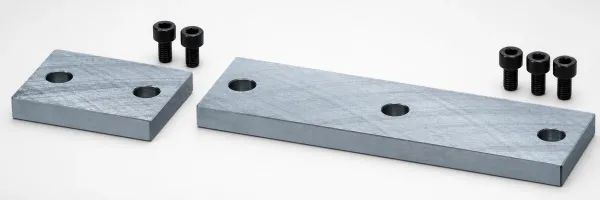
Pairing Guide
| If You're Using... | Add Stopper Plate? | Why |
|---|---|---|
| Guide Bushings | ✅ Required | Prevents axial pullout under clamp force + thermal cycling |
| Leader Bushings | ✅ Required | Same as above — especially critical for large molds |
| Ejector Guide Bushings | ✅ Recommended | Prevents migration from repeated ejection cycling |
Engineering note: Stopper plates must be ground flat to within 0.02 mm to ensure even load distribution. Uneven stopper plates cause rocking during impact, leading to accelerated wear and plate cracking. For material properties and application guidelines, see our Why 1045 Steel Stopper Plates Are Essential in Die Casting Molds.
Why Stopper Plates Are Essential in Die Casting
Die casting molds experience more severe thermal cycling than injection molds (ΔT = 200–400°C per cycle vs 20–60°C). This causes:
- Bushing-bore interference reduction as bore expands faster than bushing (different thermal mass)
- Progressive axial creep — each cycle pushes the bushing fractionally outward
- After 50,000+ cycles, bushing may protrude 0.5–2 mm, causing misalignment
Stopper plates provide a mechanical stop independent of interference fit, ensuring zero axial migration regardless of thermal conditions.
Decision rule: Without stopper plates, cyclic clamping force progressively pushes bushings deeper into bores, causing progressive alignment loss and flash. For detailed guidance, see our Why 1045 Steel Stopper Plates Are Essential in Die Casting Molds.
Frequently Asked Questions
What components does a die cast stopper plate pair with?+
Why is 1045 steel used for die cast stopper plates?+
What thickness options are available?+
Engineering Resources
Need Stopper Plates?
Specify bushing OD, mold clamp tonnage, and number of bushings.