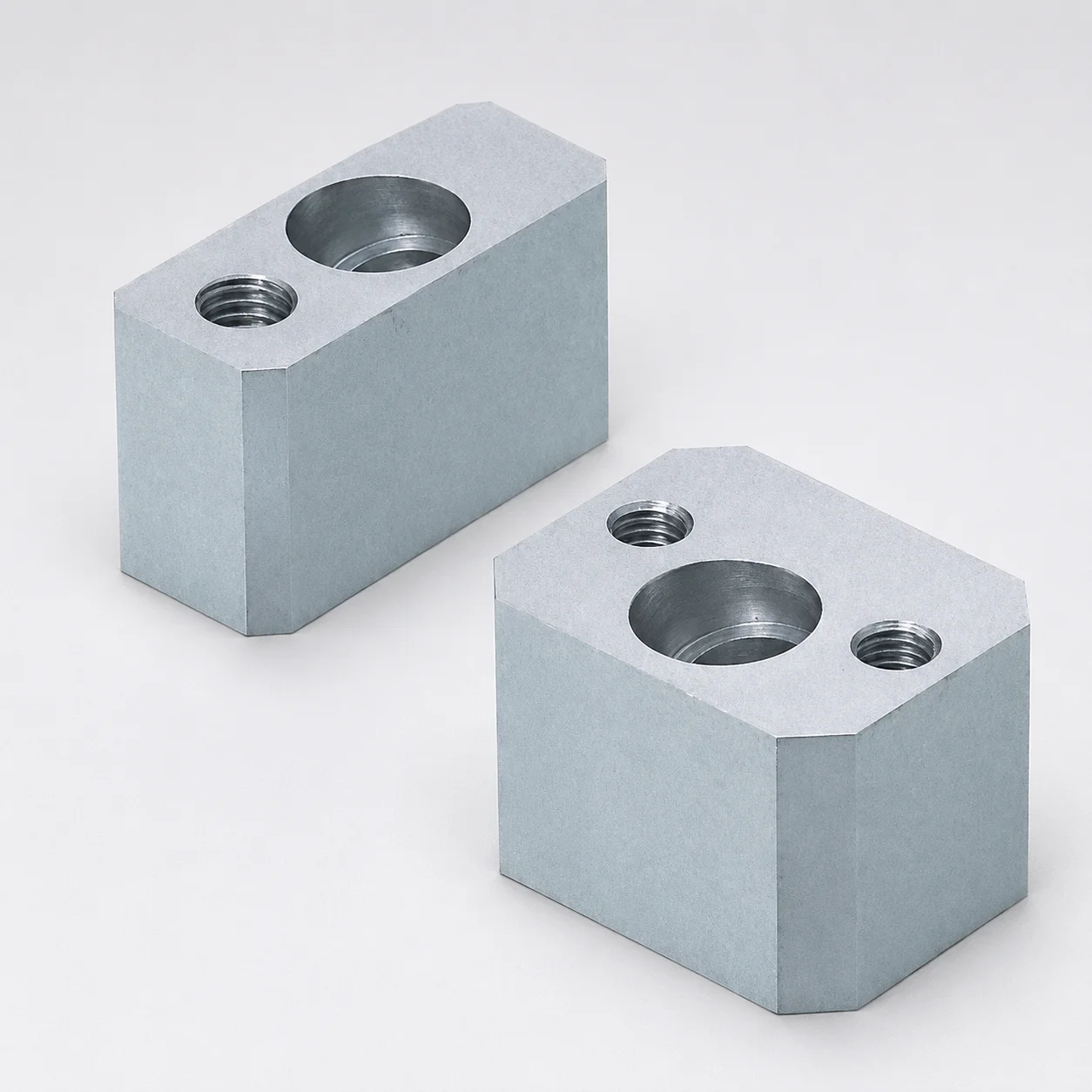
Retainer Angular Pins Single/Double Mounting Bolt Holes
Retainer angular pins are engineered to secure components using single or double mounting bolt holes, helping maintain stable positioning and repeatable alignment in mechanical assemblies. Built for dependable clamping performance, they support smoother operation and reduced wear in production.
- Single or double mounting bolt hole arrangement for secure clamping stability
- Selectable S45C or HPM2T-comparable steel options for robust durability
- Designed for consistent fit to support accurate alignment during assembly cycles
- Suitable for machinery, automotive, and automation equipment where retention reliability matters
Specifications
44 configurations available
| Material | Number of Retainer Clamping Bolts | D (Angular Pin Diameter) (mm) | A (Angle) (°) | T (Thickness) (mm) | TC (Thickness alteration) (mm) | type |
|---|---|---|---|---|---|---|
| HPM2T comparable | 1 | 8 | 10 ~ 20 | 20 | - | - |
| HPM2T comparable | 1 | 8 | 10 ~ 20 | - | 10 ~ 19.9 | - |
| HPM2T comparable | 1 | 10 | 10 ~ 20 | 25 | - | - |
| HPM2T comparable | 1 | 10 | 10 ~ 20 | - | 12.5 ~ 24.9 | - |
| HPM2T comparable | 1 | 13 | 10 ~ 20 | 30 | - | - |
| HPM2T comparable | 1 | 13 | 10 ~ 20 | - | 15 ~ 29.9 | - |
| HPM2T comparable | 1 | 16 | 10 ~ 20 | 35 | - | - |
| HPM2T comparable | 1 | 16 | 10 ~ 20 | - | 17.5 ~ 34.9 | - |
| S45C | 1 | 8 | 10 ~ 20 | 20 | - | - |
| S45C | 1 | 8 | 10 ~ 20 | - | 10 ~ 19.9 | - |
| S45C | 1 | 10 | 10 ~ 20 | 25 | - | - |
| S45C | 1 | 10 | 10 ~ 20 | - | 12.5 ~ 24.9 | - |
| S45C | 1 | 13 | 10 ~ 20 | 30 | - | - |
| S45C | 1 | 13 | 10 ~ 20 | - | 15 ~ 29.9 | - |
| S45C | 1 | 16 | 10 ~ 20 | 35 | - | - |
| S45C | 1 | 16 | 10 ~ 20 | - | 17.5 ~ 34.9 | - |
| HPM2T comparable | 2 | 8 | 10 ~ 20 | 20 ~ 25 | - | - |
| HPM2T comparable | 2 | 8 | 10 ~ 20 | - | 10 ~ 24.9 | - |
| HPM2T comparable | 2 | 10 | 10 ~ 20 | 25 ~ 30 | - | - |
| HPM2T comparable | 2 | 10 | 10 ~ 20 | - | 12.5 ~ 29.9 | - |
| HPM2T comparable | 2 | 13 | 10 ~ 20 | 30 ~ 35 | - | - |
| HPM2T comparable | 2 | 13 | 10 ~ 20 | - | 15 ~ 34.9 | - |
| HPM2T comparable | 2 | 16 | 10 ~ 20 | 35 ~ 40 | - | - |
| HPM2T comparable | 2 | 16 | 10 ~ 20 | - | 17.5 ~ 39.9 | - |
| HPM2T comparable | 2 | 20 | 10 ~ 20 | 40 ~ 45 | - | - |
| HPM2T comparable | 2 | 20 | 10 ~ 20 | - | 20 ~ 44.9 | - |
| HPM2T comparable | 2 | 25 | 10 ~ 20 | 45 ~ 50 | - | - |
| HPM2T comparable | 2 | 25 | 10 ~ 20 | - | 22.5 ~ 49.9 | - |
| HPM2T comparable | 2 | 30 | 10 ~ 20 | 55 ~ 60 | - | - |
| HPM2T comparable | 2 | 30 | 10 ~ 20 | - | 27.5 ~ 59.9 | - |
| S45C | 2 | 8 | 10 ~ 20 | 20 ~ 25 | - | - |
| S45C | 2 | 8 | 10 ~ 20 | - | 10 ~ 24.9 | - |
| S45C | 2 | 10 | 10 ~ 20 | 25 ~ 30 | - | - |
| S45C | 2 | 10 | 10 ~ 20 | - | 12.5 ~ 29.9 | - |
| S45C | 2 | 13 | 10 ~ 20 | 30 ~ 35 | - | - |
| S45C | 2 | 13 | 10 ~ 20 | - | 15 ~ 34.9 | - |
| S45C | 2 | 16 | 10 ~ 20 | 35 ~ 40 | - | - |
| S45C | 2 | 16 | 10 ~ 20 | - | 17.5 ~ 39.9 | - |
| S45C | 2 | 20 | 10 ~ 20 | 40 ~ 45 | - | - |
| S45C | 2 | 20 | 10 ~ 20 | - | 20 ~ 44.9 | - |
| S45C | 2 | 25 | 10 ~ 20 | 45 ~ 50 | - | - |
| S45C | 2 | 25 | 10 ~ 20 | - | 22.5 ~ 49.9 | - |
| S45C | 2 | 30 | 10 ~ 20 | 55 ~ 60 | - | - |
| S45C | 2 | 30 | 10 ~ 20 | - | 27.5 ~ 59.9 | - |
Product Guide
Application Scenarios+
These retainer angular pins are used in large-scale injection mold tooling and die-casting assembly fixtures where precise component positioning must be maintained across repeated clamping cycles. They are commonly incorporated into machinery mold base subassemblies, using the single or double mounting bolt hole configuration to stabilize alignment between plates, slides, or die components.
In automotive and industrial connector mold builds, the angular engagement helps resist part-to-part shifting during high-cycle tightening, supporting consistent shut-off alignment. The 10–20° angle range and available thickness (20–55 mm) make this variant suitable for controlling lateral retention without over-constraining the system.
For automation equipment and production fixtures, selecting the correct pin diameter (D = 8–30 mm) allows reliable clamping stability around multiple bolt patterns (1 or 2). The steel options (S45C or HPM2T-comparable) further support long service life under moderate wear conditions.
Material & Process Details+
This series is available in S45C or HPM2T-comparable steel. S45C is a carbon steel commonly used for components requiring good toughness and machinability, typically balancing wear resistance with impact tolerance in industrial assemblies.
HPM2T-comparable steel (high-performance tool steel class) is selected when higher wear resistance and improved dimensional stability under repetitive contact are needed. Compared to S45C, the trade-off is that higher hardness requirements can reduce toughness if not properly heat-treated and matched to load conditions.
- HRC / hardness: Not specified in the provided data, so final hardness should be verified against the supplier’s heat-treatment standard for the selected grade.
- Heat treatment state: Not specified; commonly for tool-steel options this includes quench & temper, and for certain applications may be paired with surface hardening (e.g., nitriding) depending on design targets.
Choose S45C for robust toughness, and HPM2T-comparable for enhanced wear resistance where repeated clamping friction and angular contact are critical.
Sizing & Selection Guide+
To select the correct angular pin retainer, match the angular pin diameter (D) and the thickness to the mating mold fixture or retainer interface. This series supports D = 8–30 mm, so start by measuring or specifying the pin pocket/bore size required by the core/cavity alignment feature.
The geometry also depends on A (Angle) = 10–20°. Ensure the chosen angle aligns with your intended retention action (lateral resistance during clamping). For stack height and bolt clearance, use T (Thickness) = 20–55 mm and TC (Thickness alteration) = 10–27.5 mm to fit the assembly without shifting the alignment datum.
- Bolts: Select 1 or 2 retainer clamping bolt version based on your bolt hole pattern.
- Tolerance & fit: The provided data does not list tolerances; design should account for machining/bore tolerance and ensure the mating interface provides reliable contact without excessive clearance.
- Fixed vs configurable: A is fixed at 10–20° for the series, while D, T, TC, and bolt count are variable.
Frequently Asked Questions
How do I choose between the single-bolt (1) and double-bolt (2) retainer angular pin versions for a mold base alignment fixture?+
What angular engagement should I design for when the retainer angular pin angle is specified as 10–20°?+
How should I pick the correct diameter (D = 8–30 mm) for mating with a mold fixture pin bore or pocket?+
What material should I select—S45C or HPM2T-comparable—for better wear resistance at the angular contact surfaces?+
How do T (20–55 mm) and TC (10–27.5 mm) affect stack-up and alignment in die-casting or large mold assemblies?+
Related Products
Need Custom Specifications?
Our engineering team can help with custom configurations, material selection, and volume pricing.