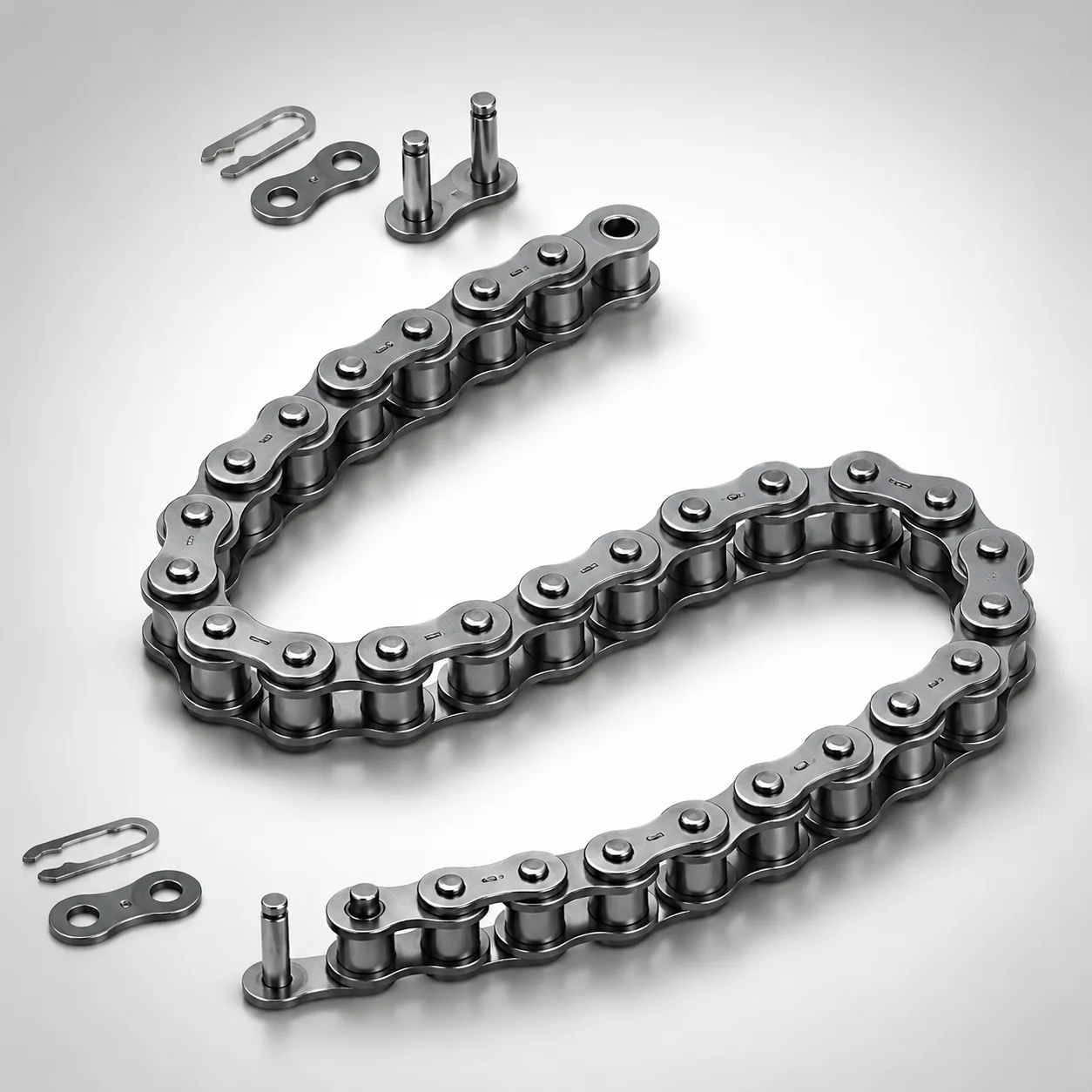
TCHE Tension Chains for Holding Plates
TCHE tension chains for holding plates are designed to maintain clamping force through a linked chain tension system. They support stable plate holding for industrial setups where consistent tension matters.
- TCHE tension chain type provides purpose-built linkage for plate clamping
- Compatible with selectable chain size options for different holding requirements
- Odd-number link count design helps match the tension length to your application
- Used in holding-plate tensioning systems across manufacturing and assembly
Specifications
4 configurations available
| Applicable chain No. (mm) | Link number (Designation in odd number) | type |
|---|---|---|
| 40 | 241 | - |
| 40 | 5 ~ 239 | - |
| 50 | 193 | - |
| 50 | 5 ~ 191 | - |
Product Guide
Application Scenarios+
This TCHE tension chain is used in injection mold tooling to keep holding plates firmly clamped during mold opening/closing cycles. The chain linkage maintains stable tension so the clamping interface resists loosening caused by repeated dynamic loading.
- Mold opening controller assemblies: Install the chain as part of the tension-link components that balance clamping force and help maintain consistent plate positioning across cycles.
- Holding-plate tensioning for industrial automation: Use chain size 40 or 50 to match the required mechanical stiffness and drive system envelope for the clamp linkage.
- Longer tension spans on multi-plate setups: Select an odd-number link count (e.g., 241, 5–239, 193, 5–191) to tune total tension length and obtain the correct take-up/adjustment behavior.
Because this variant is specified by selectable chain size and odd-number link counts, it is suited for applications where precise tension-length matching is necessary for reliable plate clamping.
Material & Process Details+
The provided product data focuses on chain linkage selection (chain No. and odd-number link counts) rather than a specific steel grade. As a result, the exact material composition, heat treatment state, and hardness (HRC) cannot be confirmed from the available specifications.
In general, tension-link components for mold-opening controllers are manufactured from hardened steels or through heat-treated alloy steels to resist wear at articulation points and maintain strength under cyclic load. Typical manufacturing routes include precision forming of chain links, heat treatment (commonly quench & tempering), and finishing to achieve stable pitch and fit between links.
- Wear vs. toughness trade-off: Higher hardness improves wear resistance at the pin/bushing interfaces, while excessive hardness can reduce impact toughness—selection should match your cycle rate and shock loading.
- Heat treatment: Look for documentation confirming quenched & tempered or equivalent hardened condition when you require measured HRC and fatigue performance.
Sizing & Selection Guide+
Select the correct TCHE tension chain by matching both the Applicable chain No. (mm) and the odd-number link count to your mold’s holding-plate clamping length and travel/take-up requirements.
- Choose chain size: Pick 40 or 50 (Applicable chain No. in mm) to fit the mechanical design envelope and the intended stiffness of the clamping linkage.
- Choose link count (odd number): Use the listed options—241, 193, or ranges of 5–239 and 5–191—to tune total chain length. The odd-number designation helps align tension geometry with the design’s required tension-length profile.
- Match cavity/core requirements: Determine the required effective tension span between holding-plate attachment points, then select the chain length using the link count as your primary tuning parameter.
If your design includes fine adjustment, verify how your system accounts for take-up; while tolerance values are not provided here, ensure the selected pitch/length maintains proper clamping force without binding through full mold stroke.
Frequently Asked Questions
Which chain size should I select for a holding-plate tensioning system: 40 mm or 50 mm?+
How do I determine the correct odd-number link count for the required tension length?+
Can TCHE tension chains be used across different holding-plate designs within mold-opening controller assemblies?+
What material and hardness (HRC) should I expect for this TCHE tension chain?+
Need Custom Specifications?
Our engineering team can help with custom configurations, material selection, and volume pricing.