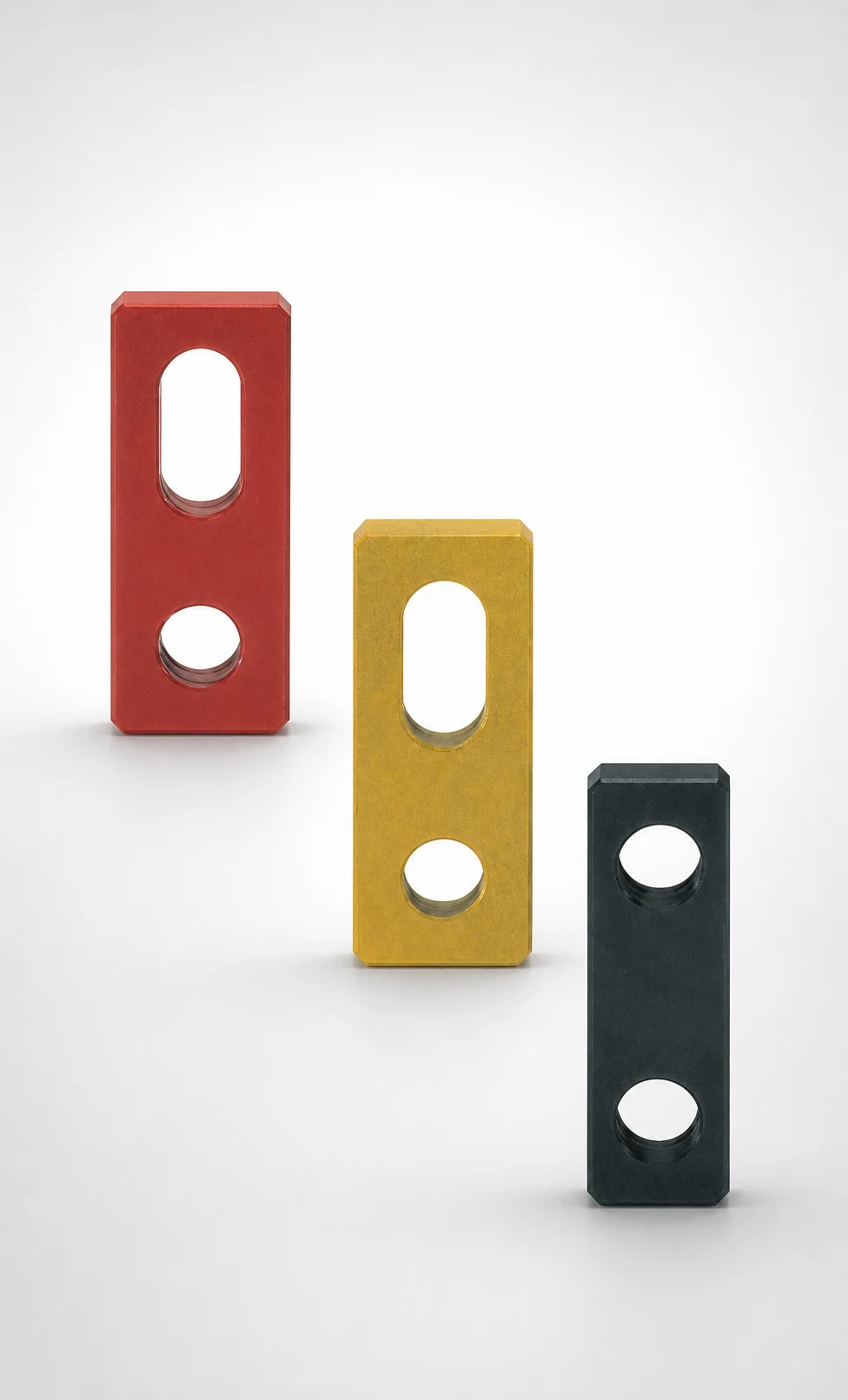
Mold Opening Prevention Plates Hole Pitch Slotted Designation
Mold Opening Prevention Plates with hole pitch, width, and hole diameter designation provide a stable way to control mold opening. The slotted layout supports flexible installation while maintaining consistent positioning on the assembly.
- Hole pitch, width, and hole diameter designation for repeatable fit-up
- Slotted hole pitch design improves mounting flexibility without guesswork
- Selectable thickness supports the rigidity needed for production cycle loads
- Available without safety coloring (or with safety colors) for clear shop-floor identification
Specifications
16 configurations available
| C/L (Hole Pitch) (mm) | B (Width) (mm) | Safety Coloring | A (L dimension) (mm) | D/d (Hole diameter) (mm) | S (Slotted hole pitch) (mm) | T (Thickness) (mm) | type |
|---|---|---|---|---|---|---|---|
| 14 ~ 186 | 16 | No Painting | 30 ~ 200 | 7 ~ 9 | - | 5 ~ 12 | - |
| 14 ~ 186 | 20 | No Painting | 30 ~ 200 | 7 ~ 9 | - | 5 ~ 12 | - |
| 18 ~ 282 | 25 | No Painting | 40 ~ 300 | 9 ~ 14 | - | 12 ~ 16 | - |
| 18 ~ 282 | 38 | No Painting | 40 ~ 300 | 9 ~ 14 | - | 12 ~ 16 | - |
| 14 ~ 186 | 16 | No Painting | 30 ~ 200 | 7 ~ 9 | 1 ~ 172 | 6 ~ 12 | - |
| 14 ~ 186 | 20 | No Painting | 30 ~ 200 | 7 ~ 9 | 1 ~ 172 | 6 ~ 12 | - |
| 18 ~ 282 | 25 | No Painting | 40 ~ 300 | 9 ~ 14 | 1 ~ 264 | 12 ~ 16 | - |
| 18 ~ 282 | 38 | No Painting | 40 ~ 300 | 9 ~ 14 | 1 ~ 264 | 12 ~ 16 | - |
| 14 ~ 186 | 16 | Red / Yellow / Black | 30 ~ 200 | 7 ~ 9 | - | 5 ~ 12 | - |
| 14 ~ 186 | 20 | Red / Yellow / Black | 30 ~ 200 | 7 ~ 9 | - | 5 ~ 12 | - |
| 18 ~ 282 | 25 | Red / Yellow / Black | 40 ~ 300 | 9 ~ 14 | - | 12 ~ 16 | - |
| 18 ~ 282 | 38 | Red / Yellow / Black | 40 ~ 300 | 9 ~ 14 | - | 12 ~ 16 | - |
| 14 ~ 186 | 16 | Red / Yellow / Black | 30 ~ 200 | 7 ~ 9 | 1 ~ 172 | 6 ~ 12 | - |
| 14 ~ 186 | 20 | Red / Yellow / Black | 30 ~ 200 | 7 ~ 9 | 1 ~ 172 | 6 ~ 12 | - |
| 18 ~ 282 | 25 | Red / Yellow / Black | 40 ~ 300 | 9 ~ 14 | 1 ~ 264 | 12 ~ 16 | - |
| 18 ~ 282 | 38 | Red / Yellow / Black | 40 ~ 300 | 9 ~ 14 | 1 ~ 264 | 12 ~ 16 | - |
Product Guide
Application Scenarios+
These mold-opening prevention plates are used in injection mold assemblies where repeatable shutoff control and secure mounting are required. In automotive connector and small housing tooling, they help manage opening behavior by providing a consistent reference geometry through the designated hole pitch (C/L), width (B), and hole diameter (D/d) positions.
In consumer electronics and appliance mold bases, the slotted layout supports faster, more flexible installation during tryout. The slotted hole pitch (S) allows engineers to fine-tune fastening locations while maintaining consistent plate positioning across production cycles.
For medical device housings and other regulated products, the thickness selection (e.g., T ranges) supports rigidity against handling and clamp-load-related vibration. Depending on shop-floor needs, safety coloring options (no painting or red/yellow/black) improve visual verification without changing the mechanical designation.
- Connector and housing molds: repeatable control via C/L, B, and D/d designation
- Electronics/appliance tooling: slotted S improves mounting flexibility
- Medical device molds: selected thickness supports stiffness for stable operation
Material & Process Details+
The provided product data does not specify a steel grade, hardness (HRC), or heat-treatment state. As a result, the material selection and post-processing cannot be confirmed from the current specifications set.
What can be stated from the available information is that the plate is offered in multiple thickness (T) ranges (e.g., 5–12 mm, 12–16 mm, or 6–12 mm variants). In mold tooling practice, thicker plates typically improve stiffness and resistance to deflection under cycle loads, while thinner plates can reduce part weight and ease packaging in constrained mold bases.
- Heat treatment: not specified in the provided dataset
- Hardness & wear: not specified; depends on the actual steel grade supplied
- Toughness trade-offs: cannot be quantified without the specified material grade and tempering/nitriding details
Sizing & Selection Guide+
To select the correct plate, match the fastening geometry to your mold base and controller mounting layout using the designated dimensions: C/L (hole pitch), B (width), and D/d (hole diameter). The hole pitch has two selectable ranges: 14–186 mm and 18–282 mm; choose the one that best matches the spacing between your mating features.
Next, confirm the plate’s overall mounting length A (L dimension) using the available ranges 30–200 mm or 40–300 mm. The slotted hole pitch (S) (available from 1–172 mm or 1–264 mm) governs how far the fasteners can be adjusted within the slot pattern—use this to accommodate minor positional differences during assembly.
- Core/cavity requirement matching: align C/L and D/d to the mating holes or threaded inserts
- Rigid fit vs. adjustability: larger S typically supports more tuning during tryout
- T (thickness): select from provided ranges (e.g., 5–12 mm, 12–16 mm) for needed stiffness
Tolerance note: the dataset does not provide tolerance values; verify tolerances against your fastener and hole-feature standards during final design.
Frequently Asked Questions
How do I choose the correct hole pitch (C/L) for a mold opening prevention plate in my assembly?+
Use C/L (hole pitch) to match the spacing between your mating fastening locations. This series offers 14–186 mm or 18–282 mm ranges, so select the range that fits your mold base geometry. Confirm that the selected pitch also aligns with the required A (L dimension) so the overall plate length matches your mounting envelope.
What are the sizing checks for hole diameter (D/d) and slot pitch (S) when installing on existing mold bases?+
The plate uses designated D/d (hole diameter) ranges of 7–9 mm or 9–14 mm. Match this to the clearance/fastener hole requirements for your controller mounting. If you need installation adjustment, choose the appropriate S (slotted hole pitch) option (available ranges 1–172 mm or 1–264 mm) to preserve positional flexibility during tryout.
Which thickness (T) range should I use to prevent deflection in high-cycle mold openings?+
This product provides multiple T (thickness) options: 5–12 mm, 12–16 mm, and 6–12 mm. For clamp-load-related vibration and handling stresses, thicker selections generally improve stiffness and reduce plate deflection. The correct choice should be based on your enclosure space and the expected cycle load, since hardness and heat-treatment details are not specified in the provided dataset.
Can the slotted design (S) compensate for minor misalignment during mold assembly?+
Yes. The slotted layout is intended to improve mounting flexibility, controlled by the S (slotted hole pitch) range (e.g., 1–172 mm or 1–264 mm). During tryout, you can tune fastener positions within the slot pattern while still using the designated C/L, B, and D/d to maintain the plate’s functional relationship to the assembly.
Does safety coloring change the mechanical fit or mounting dimensions of the prevention plate?+
The dataset lists safety coloring options as No Painting or Red / Yellow / Black, but it does not indicate any change to the mechanical dimensions. When specifying for your mold, base the fit-up selection on C/L, B, A, D/d, S, and T. Choose coloring primarily for shop-floor identification needs.
Related Products
Need Custom Specifications?
Our engineering team can help with custom configurations, material selection, and volume pricing.