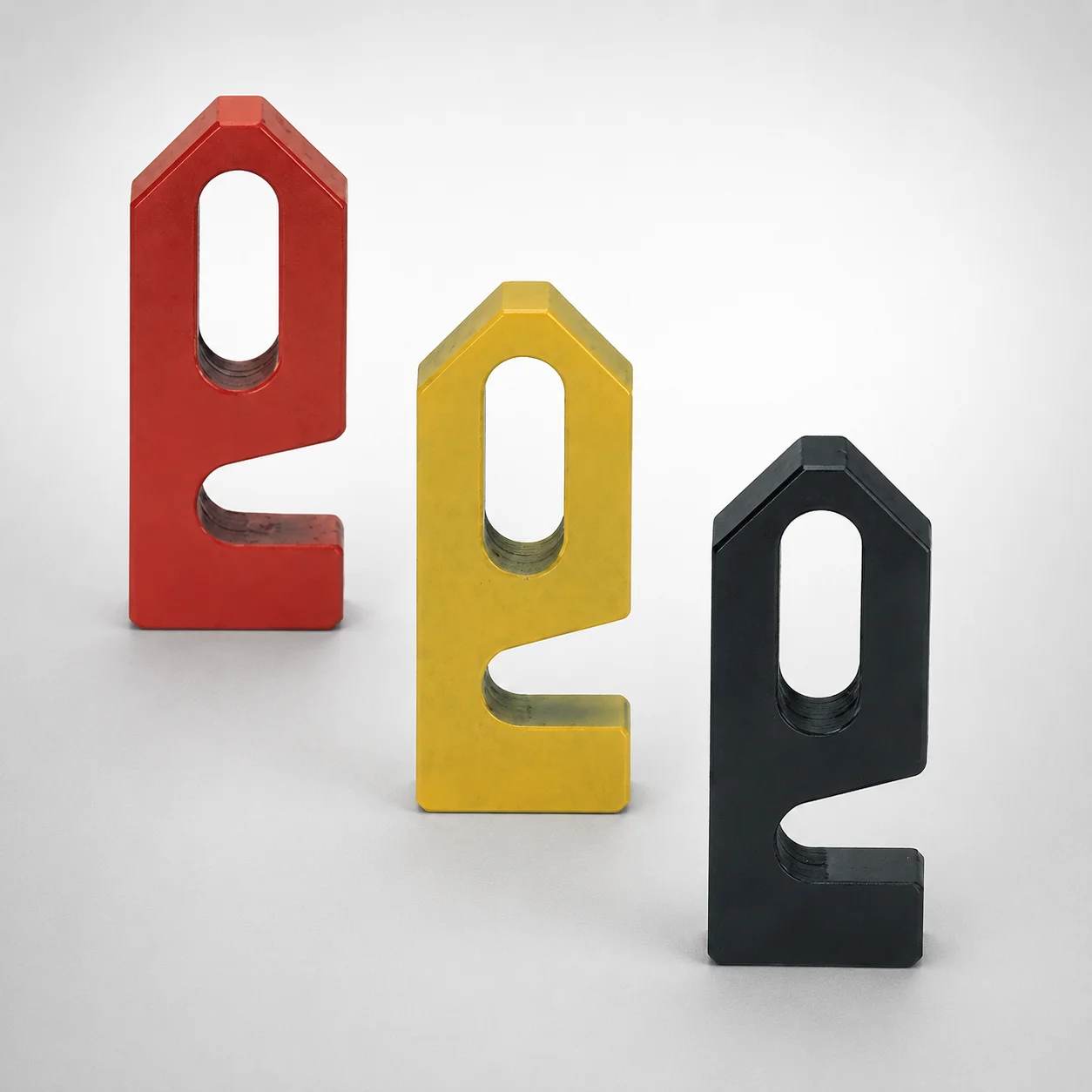
DPPFN Cut-Out L Dimension Mold Opening Prevention Plates
DPPFN cut-out L dimension mold opening prevention plates provide a configurable cut-out position based on hole pitch and width designation, helping control mold opening safely in production. The DPPFN format supports fast selection for line setup and consistent results.
- Cut-out L dimension designation type aligns hole pitch and width to define the cut-out location
- Hole pitch + width designation structure supports accurate, repeatable installation
- Configurable C/L hole pitch range and selectable B width values fit varied mold layouts
- Compatible with industrial safety requirements using optional coloring for easy identification
Specifications
3 configurations available
| C/L (Hole Pitch) (mm) | B (Width) (mm) | Safety Coloring | S (Slotted hole pitch) (mm) | type |
|---|---|---|---|---|
| 30 ~ 95 | 25 | Red / Yellow / Black | 0 ~ 77 | - |
| 50 ~ 115 | 38 | Red / Yellow / Black | 0 ~ 87 | - |
| 60 ~ 145 | 50 | Red / Yellow / Black | 0 ~ 101 | - |
Product Guide
Application Scenarios+
In injection mold tooling, mold opening prevention plates are used to limit or control how far a mold can open, helping protect operators and downstream equipment during line start-up, maintenance, or high-cycle production.
This DPPFN cut-out L dimension plate is well-suited for automotive connector molds, where consistent clamp/open behavior must be maintained across repeated builds and minor layout changes. The configurable cut-out position—defined by hole pitch (C/L) and width designation (B)—supports precise safety geometry without requiring custom patterning for every mold revision.
It is also used in appliance and consumer electronics housings, where accessory fixtures and safety labeling improve traceability on the shop floor. The available fixed safety coloring (Red / Yellow / Black) helps technicians quickly identify the correct plate version during installation.
- Cut-out location matched to hole pitch + width to maintain repeatable installation
- Slotted hole pitch (S) range supports fit to varied mounting layouts
- Color identification improves line setup efficiency and reduces mix-ups
Material & Process Details+
The provided product data does not specify the steel grade, heat treatment state (e.g., pre-hardened, quenched & tempered, nitrided), or target hardness (HRC). As a result, material-specific claims such as wear resistance rating, toughness trade-offs, or an SKD61/H13-style equivalency cannot be verified from the input.
For engineering selection, confirm the supplier’s datasheet for:
- Steel grade (e.g., SKD61/H13 equivalent for hot-work die steel applications, or a hardened stainless option where corrosion resistance is required)
- Heat treatment (quench & temper, nitriding, or pre-hardened condition)
- Hardness (HRC) to balance wear resistance against risk of chipping or deformation
If multiple materials are offered for this DPPFN series, compare them using the verified hardness and tempering/finishing process rather than assuming performance based on geometry alone.
Sizing & Selection Guide+
Selection is driven by matching the plate’s defined cut-out L dimension to your mold opening prevention layout. Use the hole pitch (C/L) and width (B) designation as the primary sizing inputs.
- C/L (Hole Pitch): choose from 30~95, 50~115, or 60~145 mm (series-dependent range).
- B (Width): select one of the available values 25, 38, or 50 mm.
- S (Slotted hole pitch): ensure your mounting layout can accommodate the slotted pitch range, which is given as 0~77, 0~87, or 0~101 mm.
To ensure proper fit, map your mold’s mounting hole pattern (pitch and slot travel needs) to the plate’s C/L positioning and verify that the slot pitch S covers the required adjustment. While the input does not provide explicit tolerance values, treat the plate as a precision safety component and confirm installation clearance and fastener fit using your mold’s specified machining tolerances and locating features.
Frequently Asked Questions
How do I choose the correct C/L hole pitch range (30–95, 50–115, or 60–145 mm) for a mold opening prevention plate?+
Select the C/L (Hole Pitch) range that matches your mold’s mounting hole pitch so the plate’s defined cut-out L position aligns with the intended safety geometry. The series offers multiple selectable C/L ranges: 30~95, 50~115, and 60~145 mm. Confirm your mold’s actual hole pitch before deciding between these ranges.
What does the B width designation (25, 38, 50 mm) control, and how does it affect the cut-out L location?+
The B (Width) value is part of the DPPFN designation structure (hole pitch + width) used to define the cut-out L dimension position. Choose B = 25, 38, or 50 mm to match the available space and the required cut-out alignment for your mold opening safety layout. Use the C/L selection together with B so the installation reproduces the correct cut-out location.
When should I rely on the slotted hole pitch S (0–77, 0–87, 0–101 mm) instead of strictly matching a fixed hole pattern?+
Use the S (Slotted hole pitch) range when your mounting requires adjustment to compensate for layout variation or when you need installation flexibility. The product data provides S ranges of 0~77, 0~87, or 0~101 mm. Ensure the required positioning travel fits within the selected S range before finalizing the plate.
Are the safety coloring options (Red / Yellow / Black) fixed, and can they help prevent installation mix-ups?+
Yes. The input data lists fixed safety coloring options: Red, Yellow, and Black. In multi-line or multi-variant mold programs, using consistent color identification supports faster line setup and helps technicians confirm they installed the correct prevention plate variant for the intended safety configuration.
What information about material and hardness is available for this DPPFN prevention plate?+
The provided product metadata does not include a steel grade, heat treatment condition, or specified hardness (HRC). Because these properties directly affect wear resistance and toughness during repeated mold operation, you should request the material datasheet for the exact DPPFN part number/variant you select. Use that verified information for compatibility with your duty cycle and safety contact conditions.
Related Products
Need Custom Specifications?
Our engineering team can help with custom configurations, material selection, and volume pricing.