Roller Lock Sets
Precision roller engagement delivers ±0.02 mm positioning accuracy with 5-10× longer service life than resin sleeve locks. The slim bushing option drops into existing PL-face bores for a direct upgrade path.
Products (1 Series)
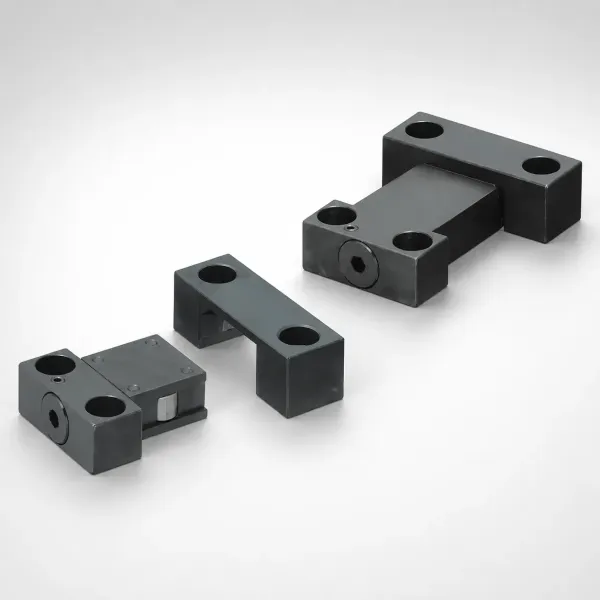
How Roller Lock Engagement Works
Rolling Contact vs Sliding Friction
Conventional resin sleeve locks rely on sliding friction between a tapered steel bolt and a polymer sleeve — friction coefficient ~0.3. Roller locks replace this with hardened steel rollers that roll along precision-ground tracks on the bolt. The rolling friction coefficient drops to ~0.01, reducing heat generation, wear debris, and force loss. Multiple rollers distribute the locking force across the full bolt circumference, enabling higher holding force from a smaller bolt diameter.
Positioning Accuracy Mechanism
The rollers seat into precision tracks machined to ±0.005 mm tolerance. This eliminates the play inherent in resin sleeve systems (where sleeve bore diameter grows with wear). Even after 500K cycles, the roller-to-track interface maintains dimensional accuracy within ±0.02 mm — critical for optical, connector, and micro-feature molds.
Technical comparison: See our How Roller Lock Sets Achieve Higher Positioning Accuracy Than Resin Sleeve Locks for detailed test data.
When to Upgrade to Roller Locks
✅ Choose roller locks when:
- Positioning accuracy below ±0.03 mm is required (optical, connector molds)
- Cycle count exceeds 500K and you want to minimize maintenance intervals
- You want to upgrade from resin sleeve without redrilling PL face
- Operating temperature is up to 200°C
🔄 Consider alternatives when:
- Resin Sleeve Locks — if ±0.05 mm accuracy is sufficient and cost is primary concern
- Magnetic Lock Sets — if zero-maintenance and zero-wear are more important than positioning accuracy
Application Scenarios
Optical Lens & Micro-Feature Molds
Molds producing optical components where surface finish and dimensional accuracy at the parting line are critical. Any misalignment creates visible witness lines.
Why it fits: ±0.02 mm positioning accuracy ensures parting line witness marks stay within optical tolerances. Low-debris operation prevents contamination of optical surfaces.
High-Cavity Connector Molds
Multi-cavity molds producing electronic connectors where pin-to-housing alignment at the parting line determines connector fit and electrical contact reliability.
Why it fits: Consistent ±0.02 mm positioning over 1M+ cycles ensures every cavity produces connectors within tolerance, reducing reject rates.
Frequently Asked Questions
How do roller lock sets achieve higher positioning accuracy than resin sleeve locks?+
What are the load and wear advantages of roller interlock systems?+
Is the slim bushing option compatible with standard parting lock mounting holes?+
Engineering Resources
How Roller Lock Sets Achieve Higher Positioning Accuracy Than Resin Sleeve Locks
Comparative analysis of roller vs sliding friction lock mechanisms with accuracy data.
When to Upgrade from Resin Sleeve to Roller Parting Lock Systems
Decision framework for evaluating the ROI of upgrading to roller lock technology.
Need a Custom Quote?
Specify your required positioning accuracy, bolt diameter, and whether you need the slim bushing option for drop-in upgrade. Contact us for multi-lock-point configurations.