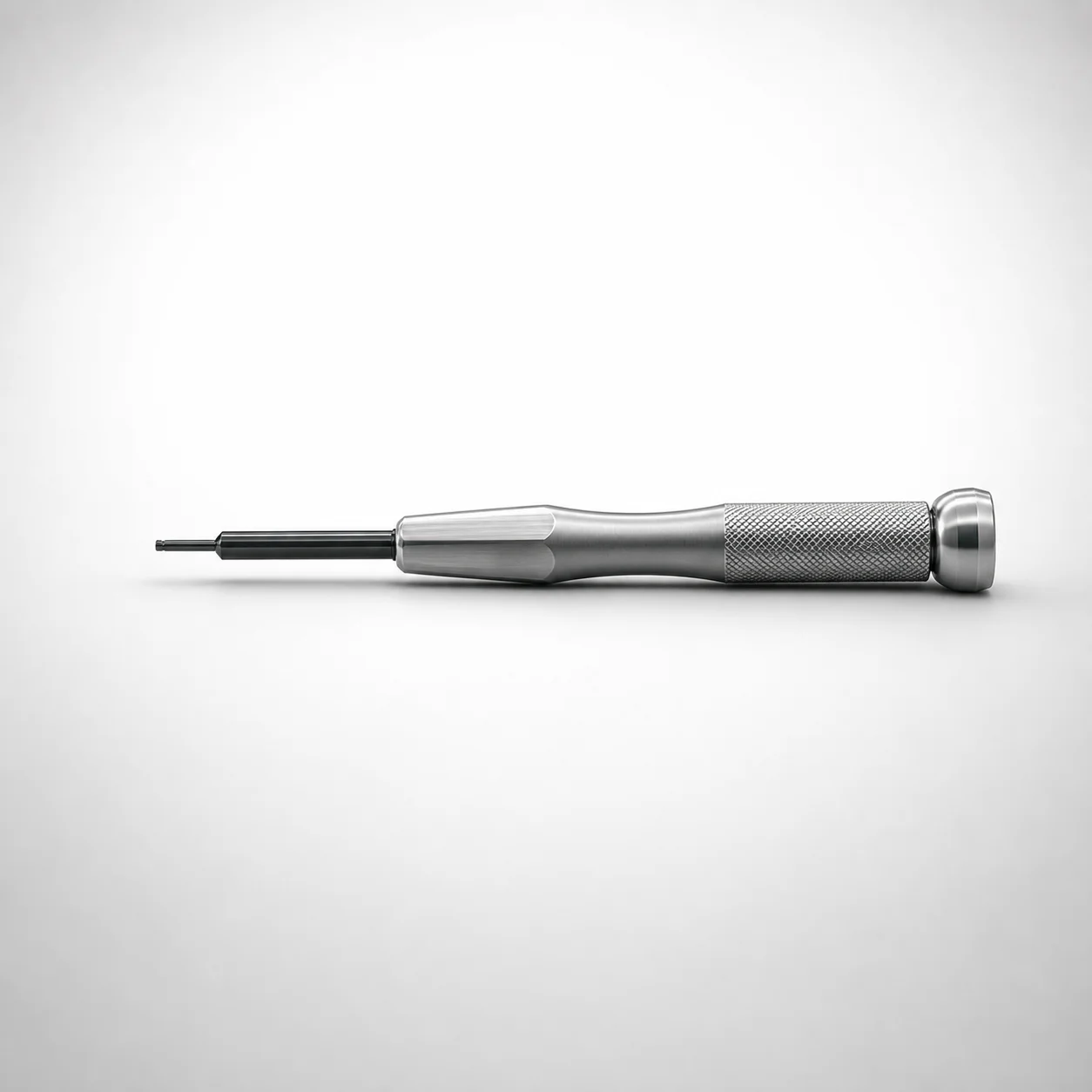
DTPPN Date Mark Pin Driver
DTPPN date mark pin driver (removal tool) is engineered for reliable handling of date-marked pins, helping operators remove them smoothly without disturbing surrounding components. The purpose-built design supports consistent service performance on production and assembly equipment.
- Specialized driver for date-marked pin removal to improve workflow efficiency
- Controlled engagement helps prevent damage to sensitive parts during disassembly
- Stable DTPPN tool type design for predictable fit across compatible pin sizes
- Recommended for maintenance tasks in manufacturing lines using date-marked components
Specifications
3 configurations available
| Applicable D-Dimension (mm) | type |
|---|---|
| 3 | - |
| 4 | - |
| 6 | - |
Product Guide
Application Scenarios+
This removal tool is used in injection mold assembly and maintenance work where date-marked pins are installed and later need controlled disassembly. It helps operators engage the pin driver precisely so the pin can be withdrawn without upsetting nearby features in the date-recycle/date-mark station.
- Date-mark inserts in packaging and household product molds: supports repeatable maintenance cycles by reducing the risk of scratching or misalignment around the date mechanism.
- High-mix production lines: the controlled engagement helps prevent damage to surrounding components during tooling changeovers and corrective maintenance.
- Gas vent/date-mark gas-vent layouts: helps keep adjacent vent-related parts stable during removal of the date-marked pin driver assembly.
The variant is suited because its D-dimension compatibility (3, 4, 6 mm) allows predictable fit for corresponding date-mark pin sizes, enabling consistent handling and reducing rework when maintaining the date-mark system.
Material & Process Details+
The provided product data specifies dimensional applicability but does not include the steel grade, hardness (HRC), heat treatment state, or manufacturing route. As a result, the exact material properties (e.g., wear resistance, toughness balance) and any heat treatment such as quenching & tempering or nitriding cannot be stated from the current specifications.
For accurate material selection in date-mark insert tooling, confirm the supplier’s datasheet for the tool steel grade and heat treatment condition, then verify the functional hardness requirement for the expected duty cycle (maintenance frequency, number of removal cycles, and exposure to debris).
- Check for the stated steel grade equivalency (e.g., H13 / SKD61 class) if you need known impact toughness vs. wear resistance performance.
- Confirm whether the part is delivered pre-hardened, or in a quenched & tempered / surface-hardened condition (e.g., nitrided) to match your expected wear pattern.
Sizing & Selection Guide+
Selection is driven by the tool’s Applicable D-Dimension (mm): 3, 4, 6. Use the D-dimension that matches the date-marked pin size in your mold’s date-recycle/date-mark station to ensure correct engagement during removal.
- Identify your pin’s D-dimension from the insert/pin drawing or BOM for the date-mark system.
- Choose the matching tool variant from the available range: D = 3 mm, 4 mm, or 6 mm.
- Tolerance/fit consideration: if your pin dimensions are at the low/high tolerance limits, verify that the driver’s engagement is still stable to avoid fretting or incomplete withdrawal.
Only the D-dimension is provided as variable in the available specs, so other dimensions (e.g., overall length, working profile) should be confirmed with the part drawing when you are checking clearances in the mold assembly.
Frequently Asked Questions
Which D-dimension should I select for the date-mark pin driver removal tool?+
Will using the wrong D-dimension risk damage to the date-recycle/date-mark components?+
Is this removal tool intended only for removal, or also for installation/engagement?+
What material grade and heat treatment should I expect for wear resistance in repeated maintenance cycles?+
Related Products
Need Custom Specifications?
Our engineering team can help with custom configurations, material selection, and volume pricing.