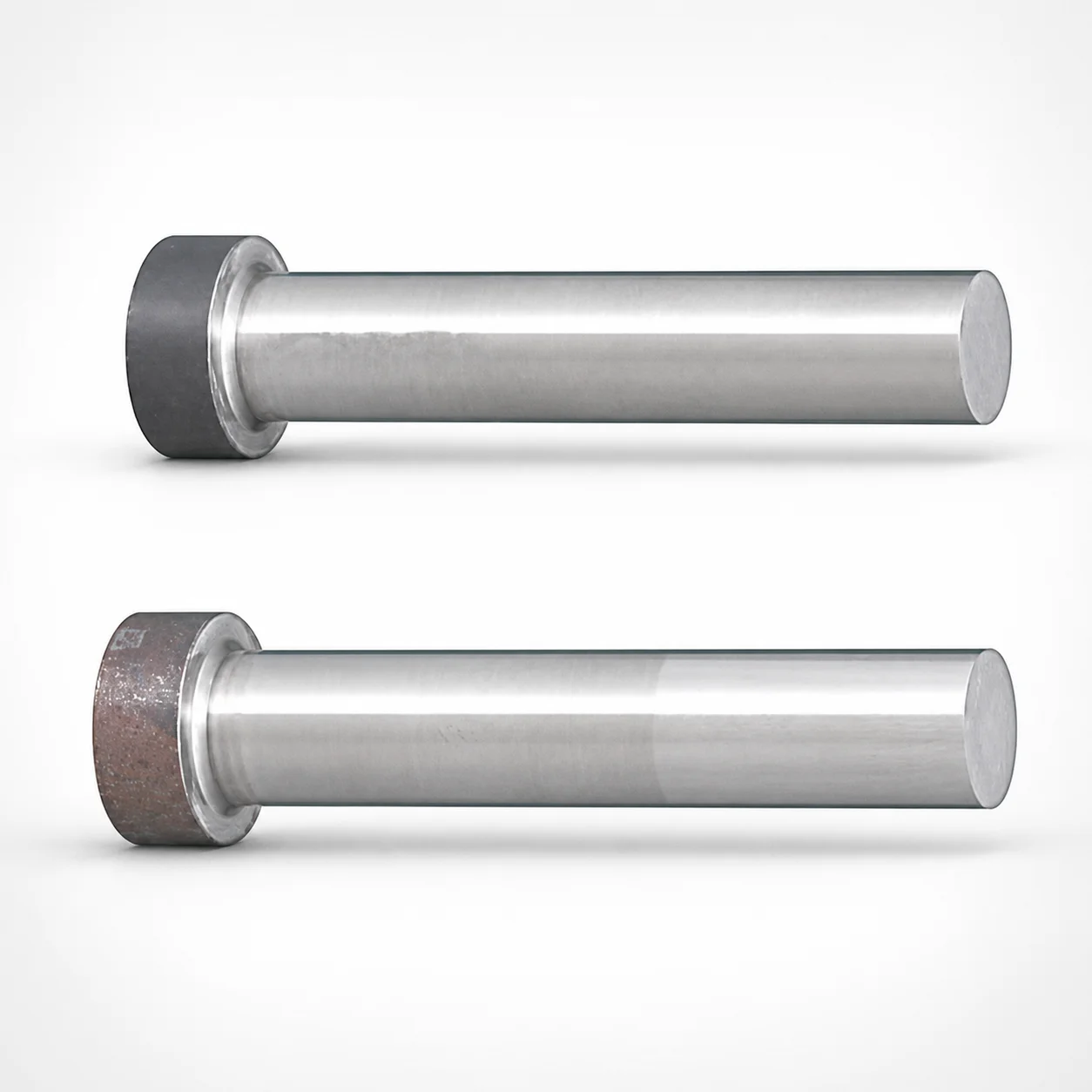
Heavy Load Straight Punches Lapping
Heavy Load Straight Punches Lapping are designed for stable punching performance in industrial press tooling. Their straight shank and standard mounting geometry support repeatable alignment under heavy-duty loads.
- Heavy-load straight punch design for consistent forming in tough applications
- Powdered high-speed steel construction (SKH51 equivalent options) improves wear durability
- Built to support accurate punch-to-die engagement and stable operation
- Compatible with standard punch holders for efficient assembly and maintenance
Specifications
36 configurations available
| Material | No. (Nominal diameter) (mm) | P (Tip dimension) (mm) | L (L dimension) (mm) | LC (Full length alteration) (mm) | type |
|---|---|---|---|---|---|
| SKH51 Equivalent | 4 | 3 ~ 4 | 40 ~ 80 | - | - |
| SKH51 Equivalent | 4 | 3 ~ 4 | - | 20 ~ 80 | - |
| SKH51 Equivalent | 5 | 4 ~ 5 | 40 ~ 80 | - | - |
| SKH51 Equivalent | 5 | 4 ~ 5 | - | 20 ~ 80 | - |
| SKH51 Equivalent | 6 | 5 ~ 6 | 40 ~ 80 | - | - |
| SKH51 Equivalent | 6 | 5 ~ 6 | - | 20 ~ 80 | - |
| SKH51 Equivalent | 8 | 6 ~ 8 | 40 ~ 100 | - | - |
| SKH51 Equivalent | 8 | 6 ~ 8 | - | 20 ~ 100 | - |
| SKH51 Equivalent | 10 | 8 ~ 10 | 40 ~ 100 | - | - |
| SKH51 Equivalent | 10 | 8 ~ 10 | - | 20 ~ 100 | - |
| SKH51 Equivalent | 13 | 10 ~ 13 | 40 ~ 120 | - | - |
| SKH51 Equivalent | 13 | 10 ~ 13 | - | 20 ~ 120 | - |
| SKH51 Equivalent | 16 | 13 ~ 16 | 40 ~ 120 | - | - |
| SKH51 Equivalent | 16 | 13 ~ 16 | - | 20 ~ 120 | - |
| SKH51 Equivalent | 20 | 16 ~ 20 | 40 ~ 120 | - | - |
| SKH51 Equivalent | 20 | 16 ~ 20 | - | 20 ~ 120 | - |
| SKH51 Equivalent | 25 | 20 ~ 25 | 40 ~ 120 | - | - |
| SKH51 Equivalent | 25 | 20 ~ 25 | - | 20 ~ 120 | - |
| Powdered high-speed steel | 4 | 3 ~ 4 | 40 ~ 80 | - | - |
| Powdered high-speed steel | 4 | 3 ~ 4 | - | 20 ~ 80 | - |
| Powdered high-speed steel | 5 | 4 ~ 5 | 40 ~ 80 | - | - |
| Powdered high-speed steel | 5 | 4 ~ 5 | - | 20 ~ 80 | - |
| Powdered high-speed steel | 6 | 5 ~ 6 | 40 ~ 80 | - | - |
| Powdered high-speed steel | 6 | 5 ~ 6 | - | 20 ~ 80 | - |
| Powdered high-speed steel | 8 | 6 ~ 8 | 40 ~ 100 | - | - |
| Powdered high-speed steel | 8 | 6 ~ 8 | - | 20 ~ 100 | - |
| Powdered high-speed steel | 10 | 8 ~ 10 | 40 ~ 100 | - | - |
| Powdered high-speed steel | 10 | 8 ~ 10 | - | 20 ~ 100 | - |
| Powdered high-speed steel | 13 | 10 ~ 13 | 40 ~ 120 | - | - |
| Powdered high-speed steel | 13 | 10 ~ 13 | - | 20 ~ 120 | - |
| Powdered high-speed steel | 16 | 13 ~ 16 | 40 ~ 120 | - | - |
| Powdered high-speed steel | 16 | 13 ~ 16 | - | 20 ~ 120 | - |
| Powdered high-speed steel | 20 | 16 ~ 20 | 40 ~ 120 | - | - |
| Powdered high-speed steel | 20 | 16 ~ 20 | - | 20 ~ 120 | - |
| Powdered high-speed steel | 25 | 20 ~ 25 | 40 ~ 120 | - | - |
| Powdered high-speed steel | 25 | 20 ~ 25 | - | 20 ~ 120 | - |
Product Guide
Application Scenarios+
Heavy-load straight punches are used in injection press tooling where consistent penetration and clean forming are required under high mechanical stress. Their straight shank and standard mounting geometry help maintain repeatable alignment, reducing variation in punch-to-die engagement during production.
Common scenarios include industrial connector and terminal cutting where thick or work-hardened sheet stock demands stable load-bearing performance. The lapping-finished contact surfaces support reliable forming contact, helping minimize localized wear and variation in part dimensions.
They are also suitable for appliance and automotive bracket punching, particularly when cyclic loads can magnify alignment drift. Powdered high-speed steel options (SKH51 equivalent) are selected for improved wear resistance, supporting longer tooling life compared with more basic tool steels.
- Choose for high-stress blanking/cutting operations requiring stable alignment
- Use where punch-to-die engagement accuracy must remain consistent over cycles
- Powdered high-speed steel supports wear durability in abrasive or hard materials
Material & Process Details+
This series is offered with SKH51-equivalent high-speed steel options, including powdered high-speed steel. SKH51 is commonly treated as an AISI M2 equivalent in terms of tool-class performance, giving a balance of hot hardness and wear resistance for punching applications.
- Powdered HSS (if selected): refined microstructure for improved wear resistance and more uniform hardness distribution
- Conventional SKH51-equivalent: good toughness, but typically less wear consistency than powdered grades
For lapping punches, hardness and toughness trade-offs depend on the heat treatment target. Typically these tool steels are supplied in a quenched & tempered condition to achieve punching-ready hardness, with subsequent finishing to control surface integrity. Expect higher hardness for improved wear resistance, while too high a hardness setting can reduce toughness under shock loading.
Sizing & Selection Guide+
Select the punch size by matching the nominal diameter and tip dimension (P) to the mold/press geometry, then confirm the available shank length (L) and full length alteration (LC) against your holder and die setup.
- No. (nominal diameter): 4 ~ 25 mm
- P (tip dimension): 3 ~ 20 mm
- L (length): 40 ~ 80 / 40 ~ 100 / 40 ~ 120 mm (order the specific range available for your configuration)
- LC (full length alteration): 20 ~ 80 / 20 ~ 100 / 20 ~ 120 mm (must align with the alteration/adjustment requirement in your tooling design)
Use the chosen No. to set punch clearance and guide fit within the punch holder, and use P to control the functional cutting/forming profile. Verify that L provides sufficient engagement without bottoming in the holder, and that LC supports your expected adjustment while maintaining alignment. If your press system requires tight fit, ensure that the selected diameter matches the holder bore specification to avoid excessive radial play.
Frequently Asked Questions
What size ranges are available for Heavy Load Straight Punches Lapping, and how do I choose the correct nominal diameter?+
Nominal diameter (No.) is available from 4 ~ 25 mm. Select No. based on your punch holder guide bore and the required clearance for stable punch-to-die alignment. After choosing the diameter, confirm the available shank L range (40 ~ 80 / 40 ~ 100 / 40 ~ 120 mm) fits your stack height.
How should I match the tip dimension (P) to my die opening and forming profile?+
The tip dimension (P) is specified from 3 ~ 20 mm. Use P to match the functional forming/blanking geometry that interfaces with your die. Because the series is designed for stable punch-to-die engagement, incorrect P selection can shift contact area and change cutting consistency.
What is the difference between SKH51-equivalent and powdered high-speed steel for punch wear performance?+
The material option includes SKH51-equivalent high-speed steel and powdered high-speed steel. Powdered HSS typically provides more uniform microstructure, supporting improved wear resistance and durability under abrasive or high-cycle conditions. For tough but less abrasive work, SKH51-equivalent can be sufficient, while powdered options are preferred when tooling life is dominated by wear.
How do I choose L and LC (full length alteration) to avoid bottoming and maintain alignment?+
L is offered in 40 ~ 80, 40 ~ 100, and 40 ~ 120 mm ranges, while LC is offered in corresponding 20 ~ 80, 20 ~ 100, and 20 ~ 120 mm ranges. Choose L to ensure adequate engagement in the holder without bottoming during full stroke. Choose LC so your adjustment range supports your tooling setup while maintaining alignment at operating load.
Are these punches intended for standard punch holders, and what matters for assembly compatibility?+
They are built to be compatible with standard punch holders for efficient assembly and maintenance. Compatibility depends primarily on matching the nominal diameter (No.) and ensuring the selected L length and LC alteration align with your holder and press stack. This helps preserve stable alignment and consistent punch-to-die engagement.
Related Products
Need Custom Specifications?
Our engineering team can help with custom configurations, material selection, and volume pricing.