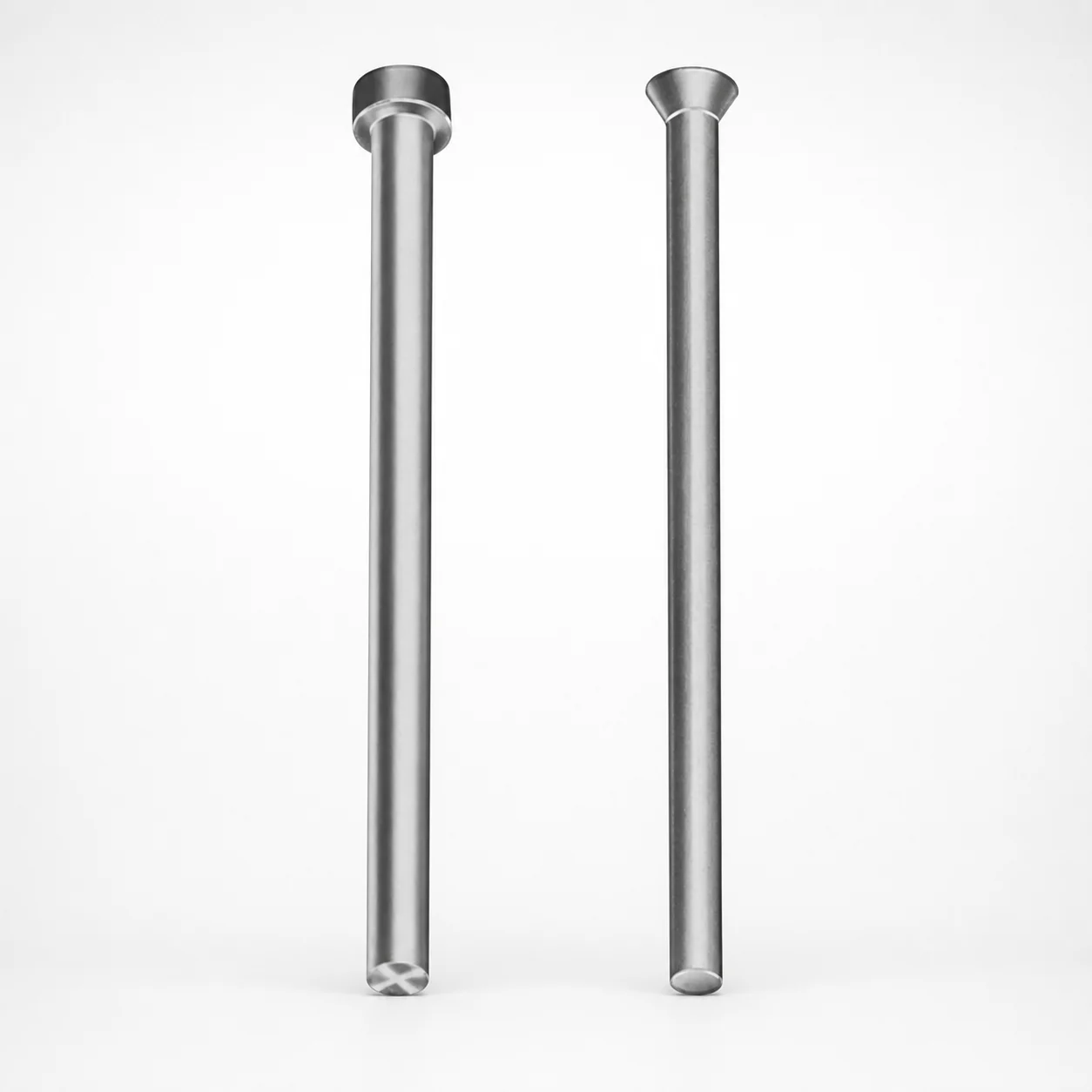
DAYTON Close Space Straight Punches - Metric XNA Coating
Close Space Straight Punches - Metric (DAYTON XNA coating) are designed for reliable ejection and guidance in tight die spaces, helping reduce scuffing and maintain consistent part formation. Ideal for precision stamping applications where clearance is limited.
- Close-space straight punch geometry supports stable alignment in confined die cavities
- XNA coating helps improve surface durability for repeated production cycles
- Two head styles are available (Angled head or Regular head) to match tooling needs
- Compatible with standard press setups for metric tooling in progressive and transfer dies
Specifications
2 configurations available
| Type | L (Length) (mm) | P Dimension (mm) |
|---|---|---|
| Angled head - AWX | 40 ~ 100 | 0.8 ~ 7 |
| Regular head - AXX | 40 ~ 100 | 0.8 ~ 7 |
Product Guide
Application Scenarios+
These close-space straight punches are used in precision progressive and transfer stamping dies where the tool must maintain guidance in very tight clearances. Their close-space geometry supports stable alignment under repeated cycling, helping reduce scuffing and helping keep ejection behavior consistent as wear develops.
In automotive and appliance terminal stamping, the angled or regular head styles help you match the punch entry/retention profile to the die layout, improving smooth operation when space is constrained between adjacent tooling and die walls. The metric build also simplifies integration into metric die standards.
For electrical contact and connector housings produced from thin sheet stock, the DAYTON XNA coating is suited to enhance surface durability and withstand high cycle counts, where friction and sliding contact are dominant wear drivers.
- Best suited for applications requiring stable press fit and long run guidance in confined die cavities
- Choose angled head for tooling that benefits from a specific head engagement geometry
- Choose regular head when a straightforward guidance profile is preferred
Material & Process Details+
The provided data specifies a DAYTON XNA coating applied to the punch surface to improve wear resistance in tight clearance die environments. This coating is intended to reduce frictional wear and scuffing during repeated press cycles where punch/die interactions are frequent.
- Coating focus: improved surface durability for long production runs
- Wear vs. toughness trade-off: in tight clearance tools, coating durability primarily improves wear life; mechanical toughness depends on the underlying punch steel grade, which is not specified in the provided parameters
Heat treatment details (e.g., quenched & tempered, nitriding, or target hardness in HRC) are not included in the supplied specification range. If you need hardness matching for a specific press load and material set, confirm the base steel grade and thermal treatment with the supplier before final die design.
Sizing & Selection Guide+
To select the correct close-space straight punch, match the die geometry to the provided metric dimensions. Use the type to align head style with your tooling design: Angled head corresponds to AWX, and Regular head corresponds to AXX.
Dimensionally, confirm L (Length) = 40 ~ 100 mm for your die stack-up and stripper/ejector clearance needs. Then verify the P Dimension = 0.8 ~ 7 mm, which should correspond to the close-space engagement/guidance requirement in your die cavity.
- First confirm your cavity/core clearances and the allowable punch projection length, then select L within 40–100 mm
- Match P within 0.8–7 mm to ensure stable alignment in the confined die space
- For press-fit interfaces, consider tightening tolerance stack-up in the die to maintain smooth operation while accommodating normal wear
In this specification set, L and P are configurable within the stated ranges; the head type choice is fixed by the AWX or AXX designation.
Frequently Asked Questions
What does the AWX vs AXX head style selection change for close-space die design?+
In this series, the Angled head is designated AWX, while the Regular head is designated AXX. Selecting between them is primarily about matching the punch head engagement and guidance profile to your die layout in tight clearances. Use AWX when your tooling design benefits from angled engagement; use AXX when a straightforward guidance geometry is preferred.
How do I choose the correct punch length (L) for a given die stack-up?+
Choose L from 40 ~ 100 mm to match your die stack-up and required punch projection. The goal is to maintain stable guidance without exceeding available clearance around the stripper and adjacent tooling. Verify your clearance envelope in the die design before finalizing the press-ready dimensions.
What P dimension range is available for this close-space punch, and how should it be matched to the die clearance?+
The P Dimension is specified as 0.8 ~ 7 mm. Match this to the close-space engagement/guidance requirement in your die cavity so the punch maintains alignment in confined conditions. Because tolerance stack-up affects sliding performance, ensure the die clearances are consistent with the selected P value.
Why is the DAYTON XNA coating relevant in tight clearance stamping dies?+
The DAYTON XNA coating is included specifically to improve surface durability in tight clearance environments. It is intended to reduce scuffing and support smoother operation during repeated production cycles. This is most beneficial when friction and sliding contact are dominant wear contributors.
Are heat treatment and hardness targets available for this punch to support material-matching decisions?+
The provided specification data confirms the XNA coating but does not include the underlying steel grade, heat treatment state, or hardness (e.g., HRC). If you need hardness matching for your press load and strip material, request the base steel grade and thermal treatment details prior to final die build. This helps ensure the punch toughness/wear performance aligns with your stamping conditions.
Related Products
Need Custom Specifications?
Our engineering team can help with custom configurations, material selection, and volume pricing.