
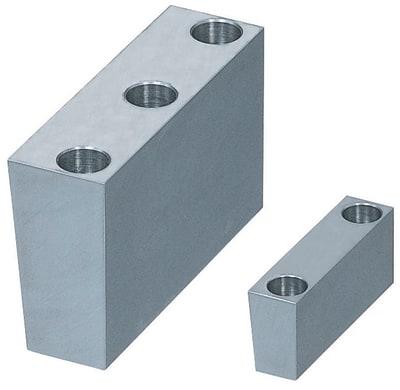
Spacers for Cavity Insert Wedge
Product Guide
Application Scenarios+
Cavity insert wedge spacers are used in injection mold tooling to maintain the designed gap between wedge elements and adjacent cavity insert surfaces. In automotive connector housings, they help stabilize cavity inserts during repetitive clamping cycles, reducing the risk of alignment drift that can lead to flash or variation in part dimensions.
For consumer electronics enclosures, wedge shims improve repeatable positioning when setting up parallel or wedge-driven cavity insert systems, supporting consistent venting and uniform packing transfer across the molded area.
In medical device housings and other high-precision parts, these spacers support dimensional accuracy and long-term stability by ensuring the same spacing every cycle, which protects sensitive insert interfaces from abnormal contact stress.
- Used during mold build/maintenance to fine-tune wedge engagement and spacing.
- Suitability comes from the component’s role in keeping spacing consistent in wedge systems, supporting dimensional control and wear reduction over time.
Material & Process Details+
The provided product data does not specify the steel grade, heat treatment state, or hardness for these MISUMI cavity insert wedge spacers. As a result, this page content cannot accurately claim whether the spacers are pre-hardened, quenched and tempered, nitrided, or otherwise heat-treated.
In general for mold components in this category, spacer materials are selected to balance wear resistance (to resist fretting or surface degradation at wedge interfaces) and toughness (to avoid cracking or deformation under clamping load). Manufacturing typically involves precision machining and inspection to ensure stable stack-up dimensions so wedge positioning remains repeatable.
- What you can confirm from the listing: MISUMI high-quality cavity insert wedge spacer components for maintaining consistent spacing in molds.
- What requires confirmation: exact alloy grade, HRC, and any surface treatment.
Sizing & Selection Guide+
Because no dimensional specification parameters are listed for this spacer series, engineers should select the correct spacer(s) by matching the required stack-up thickness for the cavity insert wedge system in the mold design.
- Step 1: Identify the wedge-driven cavity insert interface in your tool (often wedge-to-insert and wedge-to-plate contact points).
- Step 2: Measure or calculate the target clearance/engagement gap required by the cavity insert wedge design.
- Step 3: Choose the spacer/shim combination whose total thickness achieves the specified spacing without over-constraining the wedge movement.
Even when exact dimensions are not stated here, treat spacer selection as a fit-and-stack problem: ensure the selected thickness supports proper positioning while avoiding excessive preload that could accelerate wear or cause parting line issues. If your drawing specifies tolerance for the gap/engagement, maintain that tolerance through spacer thickness and cumulative stack-up controls.
If multiple spacer sizes are available in the same series, they are typically configurable by thickness; confirm the specific thickness value in the internal part number for your quote.
Frequently Asked Questions
How do cavity insert wedge spacers affect alignment and part dimensional accuracy?+
What spacer thickness should I select for my wedge engagement gap?+
Is this spacer intended for parallel wedge configurations or other wedge systems?+
What steel grade and hardness are used for this MISUMI spacer series?+
How do I avoid wear or fretting at the wedge interface when using spacers?+
Related Products


Need Custom Specifications?
Our engineering team can help with custom configurations, material selection, and volume pricing.