
Cavity Insert Wedges - Parallel Surfaces
Product Guide
Application Scenarios+
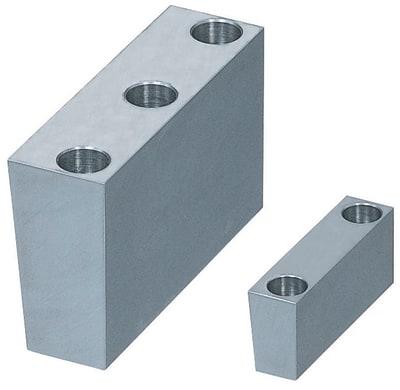
This parallel-surface cavity insert wedge is used inside injection mold tooling when a designer needs controlled movement and stable positioning of an undercut-handling component. In undercut plate and slide setups, the wedge helps secure mating surfaces so the cavity features maintain alignment during clamping and ejection.
- Automotive and appliance parts with undercuts: use the wedge to support cavity insert wedges in block/core pin systems where repeatable positioning reduces flash risk.
- Electrical connector housings: the parallel contact geometry supports consistent insertion depth, helping maintain dimensional stability across production cycles.
- Industrial housings and casings: suited for applications that benefit from predictable contact behavior on mating wedge faces, improving support and repeatability.
Because this variant is designed for parallel surfaces, it promotes uniform contact and reliable seating in the cavity insert interface—critical for undercut-related mold accuracy.
Material & Process Details+
The wedge is specified as SKS3. SKS3 is a Japanese equivalent steel commonly used for mold components that require good machinability and reliable dimensional stability after heat treatment. While the exact HRC value is not provided in the available data, SKS3 parts are typically hardened by quenching and tempering to balance wear resistance and toughness for sliding/locking interfaces.
- Wear resistance: suitable for components that experience contact wear at the wedge mating surfaces.
- Toughness trade-off: increasing hardness can improve abrasion resistance, but excessive hardness may reduce impact toughness; SKS3 selections generally target a practical balance for tooling inserts.
- Manufacturing: produced as a precision machined wedge so parallel faces maintain consistent contact during assembly.
If higher wear and abrasion resistance are required than SKS3 provides, engineers often compare against harder tool steels (e.g., H-series steels), but that comparison is outside the provided specifications for this item.
Sizing & Selection Guide+
Select dimensions by matching the wedge to the cavity insert wedge seat in your mold cavity/core block and undercut system. Because the provided data does not list shaft/length ranges or numeric dimensions, verify the drawing/part compatibility using the SKU 110200046040 and the mating geometry in your assembly CAD.
- Parallel-surface engagement: confirm the wedge’s parallel faces correspond to the mating surfaces so that the seating depth is consistent across the part width.
- Cavity alignment: ensure the wedge position maintains the intended cavity insert location to reduce misalignment-related flash or undercut mismatch.
- Tolerance/fit: plan for assembly clearances per your mold tolerance strategy. For wedge interfaces, small dimensional deviations can affect contact area and repeatability during clamping/ejection.
Use the manufacturer’s component drawing for exact overall dimensions and tolerances, then mirror the wedge’s interface surfaces in the cavity insert wedge pocket to guarantee proper fit.
Frequently Asked Questions
What does the “parallel surfaces” wedge geometry imply for undercut wedge seating in cavity inserts?+
The parallel-surface design is intended to create consistent contact on the wedge mating faces, which helps maintain stable positioning in the cavity insert interface. For undercut plates or wedge-based locking arrangements, this uniform seating can reduce variation during repeated mold cycles.
Is this wedge suitable for sliding/locking interfaces in injection molds, given its SKS3 steel selection?+
The component is specified in SKS3, a practical mold steel choice that balances machinability with post-heat-treatment performance. This makes it appropriate for wedge interfaces that experience contact wear and require predictable fit stability.
What hardness (HRC) is provided for SKS3 in this wedge, and does the data include heat-treatment state?+
No explicit hardness in HRC and no explicit heat-treatment state (e.g., quenched & tempered, nitrided) are provided in the available product data. For accurate HRC verification, use the manufacturer’s detailed specification drawing tied to SKU 110200046040.
What dimensions should I use for cavity/core pocket design if the specification ranges are not listed?+
This dataset does not include numeric dimensional ranges for the wedge. You should obtain the exact overall dimensions and interface geometry from the manufacturer’s drawing for SKU 110200046040, then design the wedge seat accordingly to ensure proper parallel-face engagement.
How does the wedge affect flash risk in undercut-related cavity insert systems?+
Because the wedge’s parallel faces promote consistent seating, it can help maintain alignment of the cavity insert interface during clamping and ejection. Misalignment and inconsistent seating are common contributors to flash in undercut systems, so ensuring correct fit and contact area is important.
Related Products


Need Custom Specifications?
Our engineering team can help with custom configurations, material selection, and volume pricing.