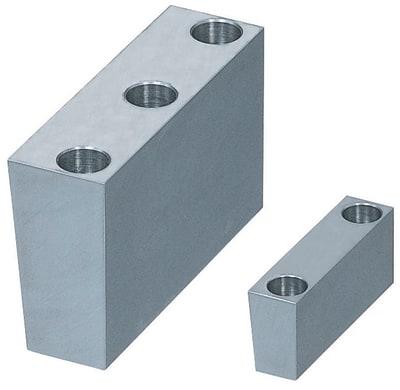
Cavity Insert Wedges - Tapered, Bolt Hole Position Configurable
Product Guide
Application Scenarios+
These tapered cavity insert wedges are used in injection mold tooling to manage undercut-related forming areas and improve the stability of wedge-type cavity insert systems. Because the bolt hole position is configurable, the wedge can be matched to the fixing scheme of a specific mold base or insert stack-up, helping maintain consistent positioning over repeated cycles.
Common scenarios include:
- Automotive connector and housing molds: the wedge supports precise alignment in high-repeat production, where small shifts can affect part fit-up and appearance.
- Consumer electronics enclosures: tapered wedge geometry helps with controlled seating of the cavity insert while allowing adaptation to different cavity layouts.
- Packaging and appliance components: the configurable bolt hole position enables integration into existing tooling without redesigning the entire mounting interface.
This variant’s emphasis on adaptable bolt-hole placement makes it well-suited when cavity geometry varies across part families or when retrofitting/standardizing tooling across multiple projects.
Material & Process Details+
The provided product data does not specify a steel grade, hardness (HRC), heat-treatment condition, or coating for this cavity insert wedge variant. For technical selection, engineers typically confirm the actual MISUMI supplied material (e.g., tool steels such as SKD61/H13 or similar) before finalizing the mold design.
When selecting a wedge insert material, key trade-offs usually include:
- Wear resistance vs. toughness: higher hardness steels improve resistance to galling and fretting at the wedge seating interface, while lower hardness or tougher grades can better withstand shock from ejector/part handling impacts.
- Heat treatment state: components are commonly supplied either pre-hardened (machinable) or quenched & tempered (final hardness), and some designs may be considered for nitriding to reduce surface wear—only after confirming the exact specification for this SKU.
Please request the drawing/material certificate for series_code 110200045860 to obtain the authoritative grade, HRC, and heat-treatment details.
Sizing & Selection Guide+
The current input data does not list measurable dimensions (e.g., wedge taper angle, thickness/width, bolt hole diameter, or overall length range) for series 110200045860. To select the correct wedge size, match the wedge mounting interface to your mold’s cavity insert wedge pocket and the required bolt-hole pattern.
Practical steps:
- Confirm seating geometry: ensure the tapered profile will fully seat in the wedge pocket without interference with adjacent plates or core/cavity features.
- Match bolt hole position: since the bolt hole position is configurable, choose the configuration that aligns with your mold base/insert fixing scheme (studs, screws, or threaded inserts).
- Tolerance/fit: use your mold assembly tolerance stack to avoid binding at the taper—maintain the intended clearance for wedge movement, while ensuring sufficient constraint to prevent micro-shift under clamp load.
If you share the cavity insert wedge pocket dimensions from your CAD (and the intended bolt pattern), we can help map them to the correct configurable variant.
Frequently Asked Questions
How do the configurable bolt hole positions affect wedge alignment in cavity insert systems?+
The bolt hole position configurability is intended to match the wedge to the specific fixing scheme of the mold’s cavity insert stack-up. By aligning the fastener locations with the wedge pocket and plate features, engineers can reduce assembly variation and help maintain consistent seating of the tapered interface. Use your CAD bolt pattern and tolerance stack to select the correct hole configuration for series 110200045860.
What steel grade and hardness (HRC) is used for MISUMI Cavity Insert Wedges in series 110200045860?+
The provided dataset does not include a steel grade, hardness value in HRC, or heat-treatment state for this SKU. For reliable wear and fatigue prediction at the wedge seating interface, obtain the MISUMI material specification or the official drawing for 110200045860. This will confirm whether the part is pre-hardened, quenched & tempered, nitrided, or otherwise surface-treated.
How should I size this tapered wedge to ensure proper seating without interference?+
The input data does not provide specific taper angle, width, or thickness ranges, so sizing must be done from the official series drawing. In general, confirm that the wedge geometry fits the wedge pocket with the designed clearance and does not interfere with adjacent plates or cavity/core features. Validate fit using CAD with your assembly tolerance stack before committing to the final bolt-hole configuration.
Can this wedge be used for retrofitting existing undercut cavity insert tooling?+
Yes, the key enabler is the configurable bolt hole position, which can help align the wedge to an existing fastening layout. When retrofitting, verify that the tapered seating surface fully contacts the pocket and that fastener access and thread engagement are compatible with your mold base. Confirm the exact dimensions and bolt pattern compatibility via the series drawing for 110200045860.
Does the wedge selection depend on wear resistance at high-cycle injection molding?+
Wedge systems experience repeated micro-motion and friction at the seating interface, so wear resistance is important for maintaining positional stability over high-cycle production. However, the specific wear-related properties (e.g., HRC, coating, nitriding) for this SKU are not provided in the input data. Request the material/heat-treatment details for 110200045860 to choose an appropriate grade for your resin type, pressure, and cycle rate.
Related Products


Need Custom Specifications?
Our engineering team can help with custom configurations, material selection, and volume pricing.