
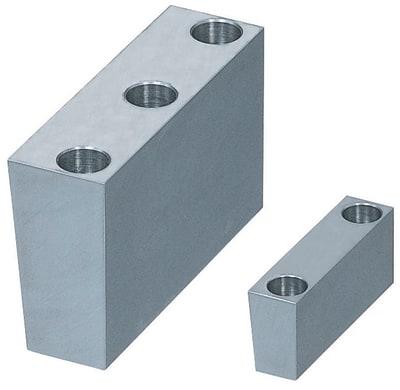
Cavity Insert Wedges - Tapered
Product Guide
Application Scenarios+
Cavity insert wedges are used in injection mold tooling to support undercut features and help maintain repeatable alignment between mating mold elements. In practice, they act as tapered locating/support components that improve positioning accuracy during closure and opening cycles.
- Automotive connector and housing molds: The wedge geometry supports stable seating of cavity insert sections in high-cycle runs, helping maintain dimensional consistency while reducing risk of micro-shifts that can affect fit and appearance.
- Consumer electronics and appliance housings: For thin-wall or multi-part inserts where reliable assembly is critical, tapered wedges enable easy insertion and removal during maintenance or tooling changeovers.
- Industrial packaging and appliance components: Their durable construction is selected to reduce wear and tolerate handling shocks, supporting longer service life of block, core, and insert subassemblies.
This tapered wedge variant is especially suited because its profile supports controlled seating and repeatable alignment without complex adjustments.
Material & Process Details+
The exact steel grade and heat treatment state are not provided in the available product specifications. However, cavity insert wedges for injection mold tooling are typically made from hardened tool steels and are selected based on a balance of wear resistance and toughness under repeated shutoff/clearing loads.
- Hardness & wear vs. toughness trade-off: Higher hardness generally improves resistance to galling and edge wear, while slightly lower hardness or improved toughness helps reduce chipping risk during impact or mis-seating.
- Heat treatment (common for this class of components): Many wedge and insert elements are supplied in pre-hardened condition or as quenched & tempered to achieve stable dimensional behavior under shop-floor use.
If multiple materials are available for this series, choose the grade that best matches the expected abrasive wear level and cycling intensity in your mold.
Sizing & Selection Guide+
Since no explicit shaft/length/tolerance ranges are listed in the provided specifications, selection should be based on matching the tapered wedge geometry to the corresponding wedge pocket or mating surfaces in the cavity/core assembly.
- Match the mating taper: Ensure the wedge taper angle and contact length correspond to the designed pocket so the insert seats fully and concentrically during mold closure.
- Coordinate with cavity insert alignment: Use the wedge to correct or lock the position of cavity insert blocks/sections, especially where undercut features require stable support.
- Check fit and tolerance approach: For reliable seating without excessive force, select the wedge size that clears assembly debris yet maintains consistent contact under repeated cycles. If you have tolerance requirements for your pocket depth and clearance, confirm compatibility with the MISUMI series variant you choose.
If you share the pocket dimensions or the specific MISUMI variant dimensions, the correct wedge size can be mapped directly to your cavity/core design.
Frequently Asked Questions
What is the role of a tapered cavity insert wedge in an undercut cavity assembly?+
A tapered cavity insert wedge provides controlled seating and locating support between insert elements. In undercut-related cavity setups, it helps maintain positional stability during closure/opening cycles, reducing the chance of small shifts that can impact part quality. Its tapered form also supports practical removal for maintenance.
How do I select the correct wedge size if detailed dimensions are not listed in the data sheet?+
Select the wedge by matching the taper geometry and contact region to the mating wedge pocket/insert surfaces used in your cavity/core assembly. Since no explicit size ranges are provided here, the most reliable method is to compare the pocket dimensions (depth, width, and taper interface) with the corresponding MISUMI series variant. If you provide your pocket drawing, the compatible size can be confirmed.
Which material or heat-treated condition is best for high-cycle injection molding?+
The ideal choice depends on the wear and load environment, but wedges in this application class are typically selected for wear resistance with adequate toughness. When multiple MISUMI materials are available for the series, higher hardness grades tend to resist galling and wear better, while maintaining enough toughness to avoid chipping under impacts. Confirm the supplied material/heat treatment option for your chosen variant to ensure it matches your cavity maintenance intervals.
Will a tapered wedge require special fitting during mold assembly?+
A tapered wedge is designed to seat progressively, which often reduces the need for complex manual shimming. However, fit still matters: the pocket and wedge surfaces must be cleaned and free of debris to achieve full seating. If your pocket tolerances are tight, verify that the chosen wedge variant provides consistent contact without excessive assembly force.
How does the wedge design help reduce wear compared with straight locating blocks?+
The tapered profile creates a controlled seating action that improves surface contact during mold closure. Better, repeatable contact can reduce localized fretting and micro-movement at the interface. This can translate into lower wear on sensitive insert/support components over long production runs.
Related Products


Need Custom Specifications?
Our engineering team can help with custom configurations, material selection, and volume pricing.