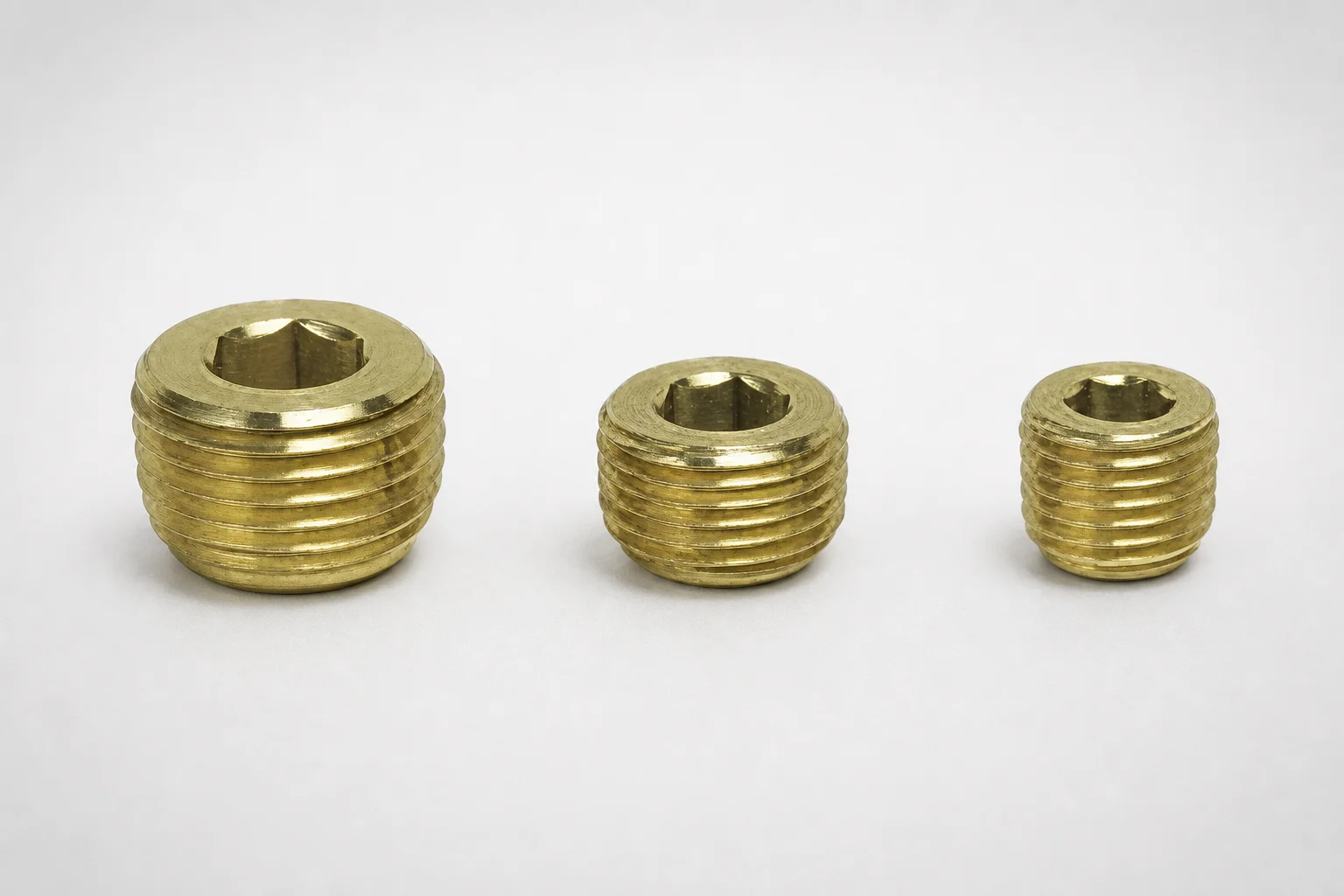
Heavy Duty Pipe Plug Fittings Solid Brass Extra-Deep Socket
Heavy Duty Pipe Plug Fittings (solid brass) provide a stronger, extra-deep socket design that resists loosening and helps prevent stripping in cooling line applications.
- Extra-deep socket improves retention strength during installation
- Solid brass construction supports reliable plugging of cooling channels
- Helps prevent strip-out for long service in industrial cooling systems
- Fits nominal 1/16"–3/4" pipe sizes for common channel layouts
Specifications
5 configurations available
| Nominal Pipe Size (in) |
|---|
| 1/16" |
| 1/8" |
| 1/4" |
| 3/8" |
| 1/2" |
Product Guide
Application Scenarios+
Where it’s used: This brass cooling-circuit plug is installed in injection mold cooling channel networks to permanently block a designated water/gas path. Its extra-deep socket is designed to enhance holding power during tightening and thermal cycling.
Scenario 1 – Automotive connector and housing molds: When multiple manifold runs feed several cavity inserts, plugs help isolate damaged or unused branches. The extra-deep socket supports stronger retention, reducing the chance of loosening that can disturb flow balance.
Scenario 2 – Medical device housings with tight thermal control: Reliable channel sealing prevents uneven cooling that can affect dimensional stability. Solid brass is suitable for plugging cooling channels where corrosion resistance and consistent sealing are required.
Scenario 3 – High-volume industrial cooling systems: Use this variant when you need reduced strip-out risk from repeated assembly/disassembly. The socket depth helps maintain engagement under installation torque.
- Used to plug cooling channels in mold interior cooling circuits
- Extra-deep socket improves retention strength
- Compatible with nominal pipe sizes 1/16"–1/2"
Material & Process Details+
Material: Solid brass provides good corrosion resistance and stable machinability for fittings used in mold cooling circuits.
Heat treatment / manufacturing: Based on the provided specs, the fitting is brass and no specific steel heat-treat state (e.g., quench & temper, nitriding) is indicated. Brass fittings are typically produced via casting or forging followed by machining and finishing to achieve thread/socket geometry.
- Wear & galling behavior: Brass generally offers reliable performance against mild wear for sealing/plugging duties, with a lower galling tendency than many harder metals in similar service environments.
- Toughness vs. hardness trade-off: As a non-ferrous alloy, brass is not selected for extreme hardness. Instead, it prioritizes dimensional stability, corrosion resistance, and dependable thread engagement for long service.
If you require a specific heat-treated alloy option, share the intended cooling media and operating pressure/temperature so we can confirm availability.
Sizing & Selection Guide+
Select by nominal pipe size: This heavy-duty plug fitting is specified for nominal pipe sizes of 1/16", 1/8", 1/4", 3/8", and 1/2". Match the fitting to the nominal size of the cooling circuit pipe/hole interface you are plugging.
How to match mold cavity/core requirements: Identify the branch you want to isolate (manifold feed line, bypass line, or unused cavity channel). Confirm the mating nominal pipe size in the cooling layout, then select the corresponding plug size so it fully engages the socket/thread interface.
- Choose the plug size that matches the circuit’s nominal pipe size
- Use the extra-deep socket to support stronger retention during tightening
- Follow your standard assembly practice for seating/torque to maintain consistent sealing
Tolerance/fit note: No tolerance ranges are provided in the data. For best results, verify that your mold drilling/tapping or tubing interface conforms to your internal standard for the selected nominal pipe size.
Frequently Asked Questions
Which nominal pipe size options are compatible with this cooling circuit plug fitting?+
This heavy-duty pipe plug fitting supports nominal pipe sizes of 1/16", 1/8", 1/4", 3/8", and 1/2". Select the size that matches the nominal pipe or tapping interface of the cooling channel branch you plan to plug.
What design feature is intended to prevent loosening in injection mold cooling channels?+
The fitting uses an extra-deep socket intended to improve retention strength during installation. This helps reduce loosening risk and supports stable performance after thermal cycling in mold service.
Is the brass material heat-treated (quenched/tempered or nitrided) for this product?+
The provided specifications indicate a solid brass fitting and do not specify any steel-grade or heat treatment state such as quenching & tempering or nitriding. Brass fittings are typically formed and machined to geometry rather than heat-treated like tool steels.
When should I choose this extra-deep socket plug instead of a standard-depth plug?+
Choose the extra-deep socket variant when you anticipate higher risk of strip-out or loosening during tightening—such as in complex cooling networks or when access for maintenance is limited. The design is aimed at stronger engagement retention for long service in industrial cooling systems.
Does this product specify tolerances for installation fit?+
No tolerance range or fit allowance is included in the provided data. For proper sealing and engagement, verify your mold interface (drill/tap or tubing connection) matches your standard for the selected nominal pipe size.
Related Products
Need Custom Specifications?
Our engineering team can help with custom configurations, material selection, and volume pricing.