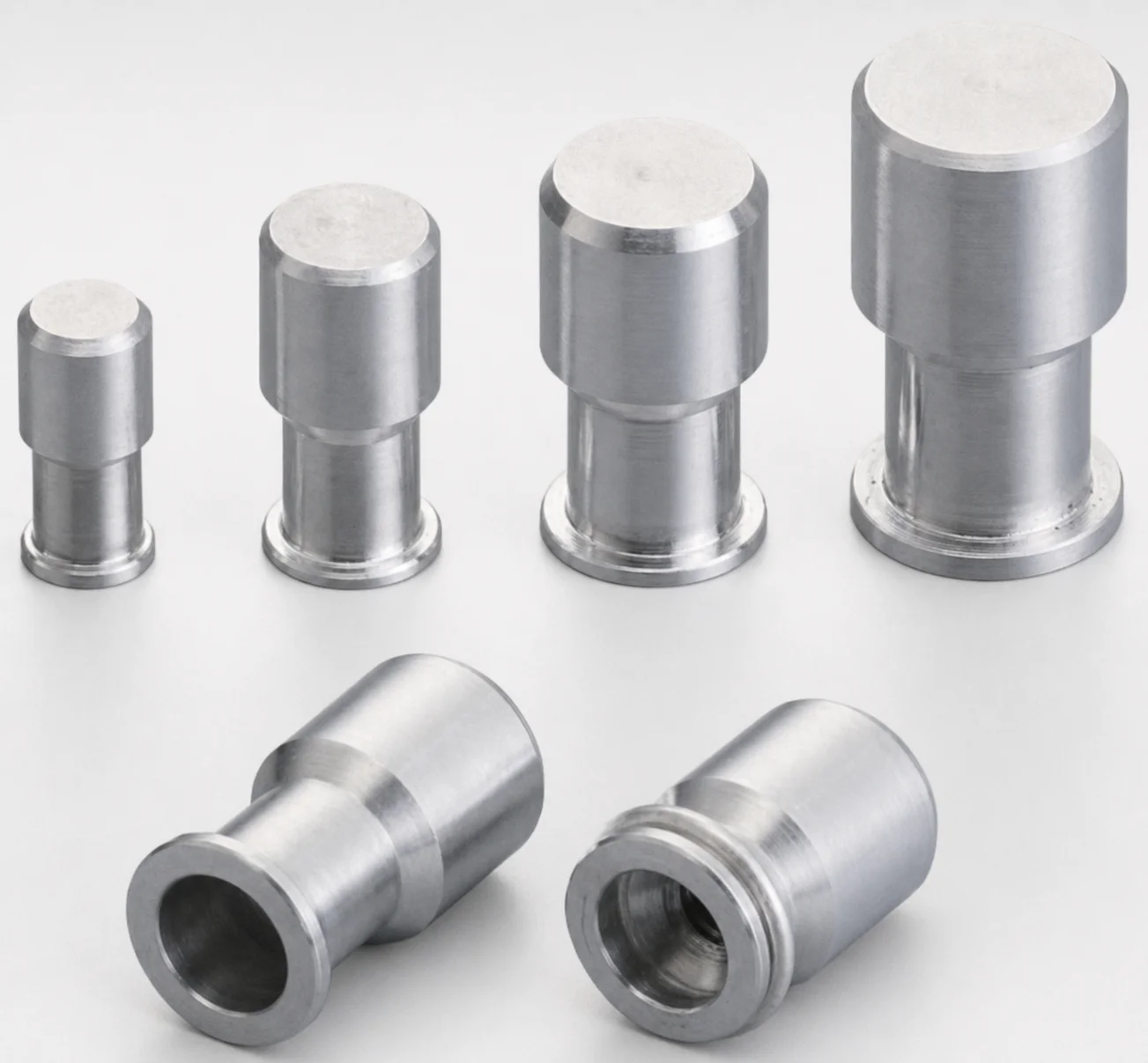
JWPZ Type Aluminum Cooling Circuit Plugs
Cooling circuit plugs (JWPZ Type) provide dependable sealing to prevent coolant leakage and help maintain stable fluid flow across automotive and industrial cooling circuits. The aluminum one-piece design supports consistent system integrity under demanding operating conditions.
- All-in-one plug design maintains effective coolant sealing to reduce leak risk
- Aluminum construction supports efficient heat management and corrosion resistance
- JWPZ Type configuration helps achieve predictable installation fit for fluid circuit reliability
- Suitable for automotive cooling and industrial machinery coolant systems
Specifications
4 configurations available
| D (Outer diameter) (mm) | type |
|---|---|
| 6 | - |
| 8 | - |
| 10 | - |
| 12 | - |
Product Guide
Application Scenarios+
JWPZ-type cooling circuit plugs are used inside injection mold tooling to seal drilled water/oil passages and maintain stable coolant flow during production cycles. Because this variant uses an aluminum one-piece body, it is commonly selected where compact packaging, predictable sealing, and good heat transfer are important.
- Automotive connector and housing molds: In molds with dense cooling networks, plugs help prevent leakage at internal circuit ends, supporting uniform thermal control and minimizing temperature-driven dimensional drift.
- Industrial machinery components: For housings and brackets produced under long-run conditions, reliable sealing supports consistent fluid flow and reduces downtime risk caused by coolant escape.
- Corrosion-prone cooling circuits: Aluminum construction is suited for applications where improved resistance to coolant-related corrosion supports longer service intervals.
Select the outer diameter that matches your drilled passage so the plug seats correctly and maintains system integrity.
Material & Process Details+
This cooling circuit plug uses a one-piece aluminum design, selected for favorable thermal behavior and corrosion resistance in coolant service. Unlike wear-critical tool steels, aluminum focuses on heat management and leak-resistant sealing performance rather than high hardness.
- Material/processing: Manufactured as a one-piece aluminum plug (no steel heat-treatment data is provided for this variant).
- Hardness & wear trade-off: Aluminum typically provides lower hardness than tool steels, so it is optimized for sealing integrity in cooling passages rather than abrasive wear environments.
- Comparison (brief): Steel cooling plugs are generally chosen when higher mechanical robustness is required; aluminum is often preferred for efficient heat transfer and corrosion resistance where sealing is the primary function.
Because no specific heat-treatment state or hardness (HRC) is listed in the provided specifications, engineers should validate hardness and process requirements based on the actual supplier datasheet for the exact aluminum grade used.
Sizing & Selection Guide+
Selection is driven primarily by the plug’s outer diameter (D), available in 6, 8, 10, and 12 mm. To match mold cavity/core requirements, identify the drilled cooling passage geometry and choose the plug size that corresponds to the intended outer fit.
- Step 1 — Match diameter: Select D = 6/8/10/12 mm to align with the passage end features where the plug will seal.
- Step 2 — Control fit: Ensure the passage finish and any counterbore/recess dimensions are compatible with the plug’s sealing surface so coolant leakage risk is minimized.
- Step 3 — Verify tolerance stack-up: Since no tolerance values are provided, confirm critical dimensions (passage diameter, seating length, and surface finish) with your molding house’s drilling specification and the component datasheet.
Dimension ranges are configurable via D; other dimensions are not specified in the provided data, so rely on the product drawing for fixed geometry details.
Frequently Asked Questions
Which outer diameter (D) should I choose for a cooling passage in my mold design?+
Select the plug based on its outer diameter (D), available at 6, 8, 10, and 12 mm. Match D to the drilled passage end/counterbore geometry where the plug seals. Because tolerances are not listed in the provided specification, verify your passage and seating dimensions against the official drawing to reduce leak risk.
Is the JWPZ aluminum cooling circuit plug suitable for coolant leakage prevention at circuit ends?+
Yes. The JWPZ-type configuration is described as providing reliable sealing to prevent coolant leakage and to help maintain stable fluid flow. The one-piece aluminum design supports consistent sealing performance in industrial cooling circuits where internal passage ends must be sealed.
What material properties should I expect—does it require heat treatment or is it hardened like tool steel plugs?+
The provided information specifies a one-piece aluminum plug design, but it does not include a steel grade, heat treatment state, or HRC hardness. This indicates the component is selected primarily for sealing and thermal/corrosion performance rather than tool-steel hardness. For hardness or any post-processing requirements, confirm the exact aluminum grade and process in the datasheet.
How do I confirm compatibility with automotive cooling circuit layouts?+
These plugs are intended for automotive cooling and industrial machinery coolant systems, where stable temperature control depends on maintaining fluid flow without leaks. In your layout, ensure the selected D size matches the internal circuit’s drilled end features, and confirm the sealing surfaces are compatible with your machining tolerances.
If I also consider steel cooling circuit plugs, what is the main trade-off versus this aluminum version?+
This aluminum plug variant is focused on efficient heat management and corrosion resistance in coolant service, while tool-steel plugs typically emphasize mechanical robustness and higher hardness. Because the provided data does not include hardness (HRC) for the aluminum plug, the most practical selection difference is whether your application prioritizes corrosion/thermal behavior (aluminum) or higher mechanical hardness (steel).
Related Products
Need Custom Specifications?
Our engineering team can help with custom configurations, material selection, and volume pricing.